-
“Lives Lived For Life” Magazine
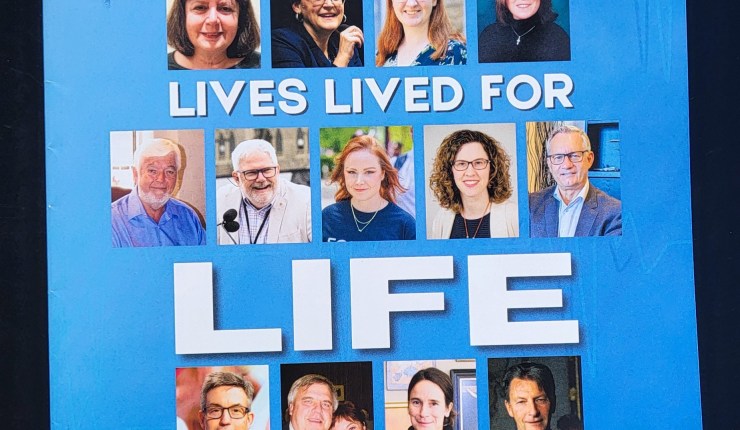
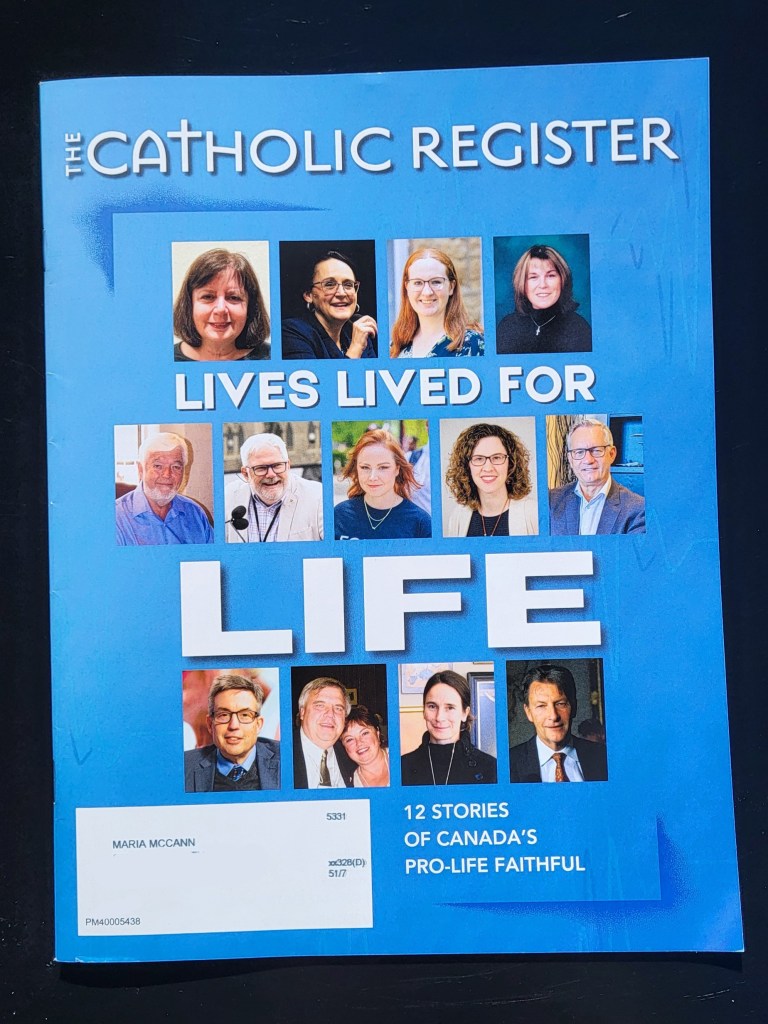
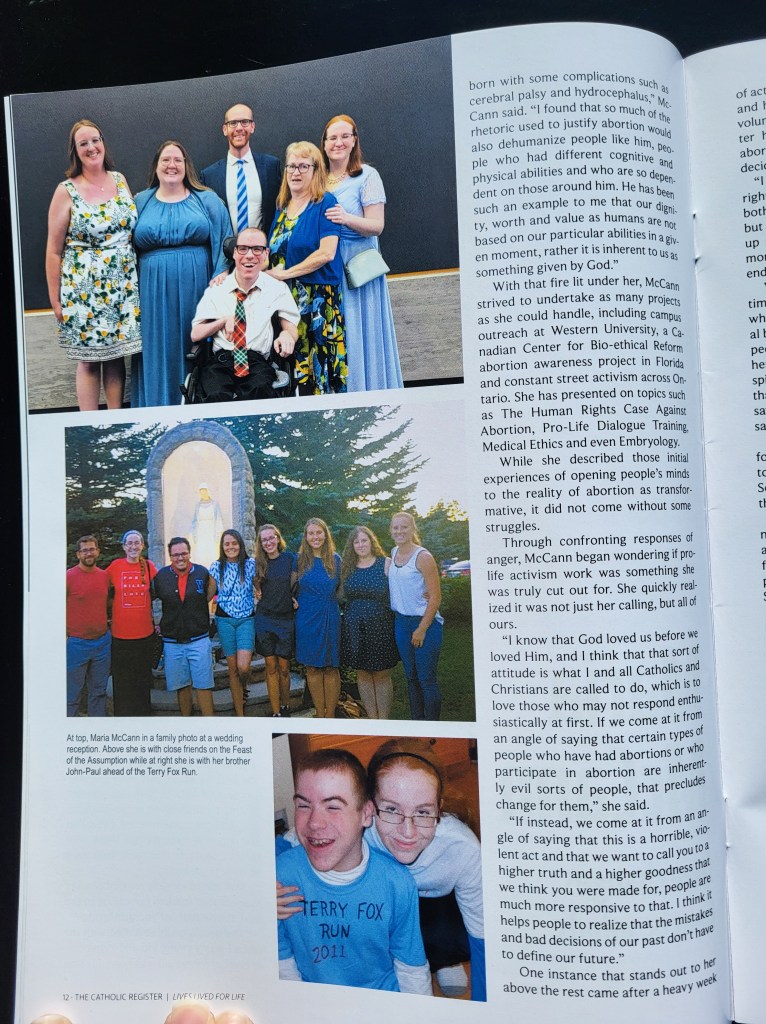
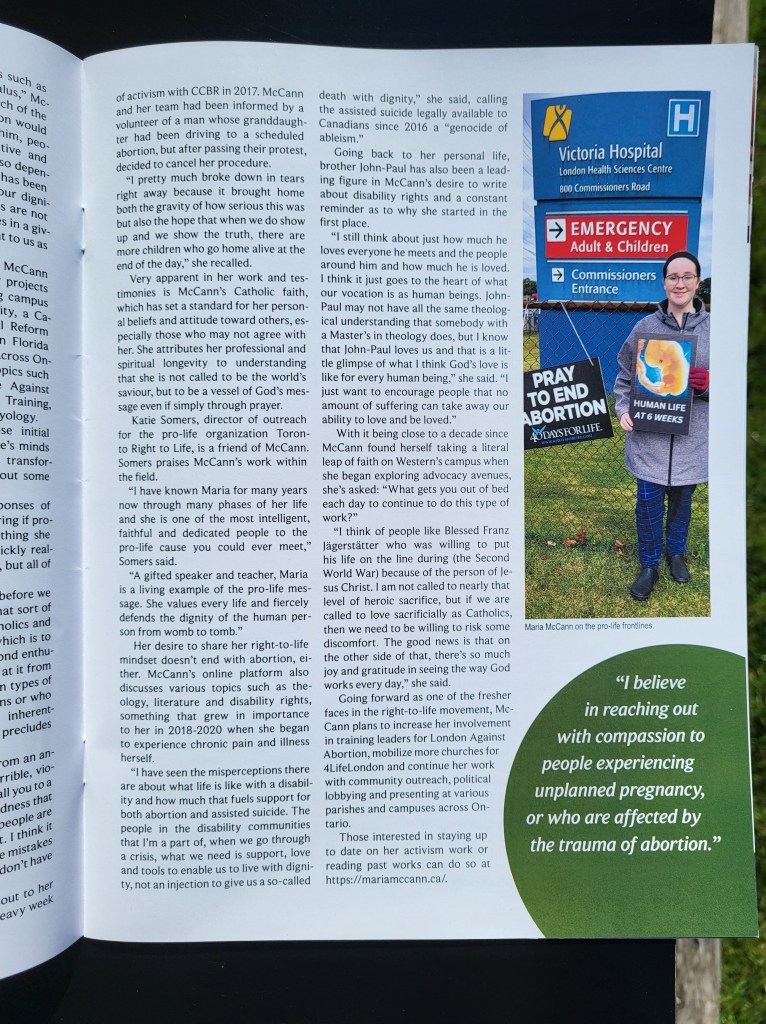
Earlier this year, I was interviewed by the Catholic Register about my involvement in the pro-life movement. I was overwhelmed and humbled to be included in their “Lives Lived For Life” issue, a special edition which highlighted 12 stories of pro-life Canadians.
My prayer is that anyone who reads the issue realizes that every one of us has a role to play in ending abortion. The pro-life movement is not about me or about you. It’s about our pre-born neighbours, little girls and boys, whom God calls us to protect from slaughter.
Get Involved: EndTheKilling.ca/TakeAction
I’m so grateful for the support of my family in doing this work, and for the countless pro-life colleagues who’ve become a second family.
Soli Deo honor et gloria!

-
Your peace may not lie

Your peace may not lie
In finding the answers
But in accepting uncertainty
In holding the immense “Why“
With tenderness
And without scorn
And if you turn your face repeatedly
Towards the flickering lights
Then one day
You may find yourself
Under a freer sky
In a street full of splendid answers–
But your heart cannot hold them yet.
Your eye has not yet seen.
Your ear has not yet heard.
No reason will satisfy
Until the immensity of that Word.
But look and listen
For the goodness here,
Even now,
In the land of the living
The promise: you will see it -
Acceptance

I [used to] think that
Acceptance
Was a synonym for Defeat
That the white flag of
Surrender
Meant giving permission for annihilation
By an enemy
So I fought
And fought and fought
And swore that I’d tear down the stars
And rearrange their atoms
Before I would bend or yield
To Reality
I’ll fight like hell, I thought smugly, I’m a fighter.
But when you fight like hell,
You win like hell
And as I clawed my way
The stars grew not nearer
And my vision darkened
Until I realized I was clawing through the mud
And had made my bed deep below the Earth
I stopped, trying to breathe [there is no air here there is no air]
And gave in to despair
And stopped fighting.
A Presence was there
Below the Earth
A Face gazing silently.
I railed and howled at Him,
Convinced He was the Engineer of my shattering
And was not enjoying it
But worse, was gazing stonily, still-faced, not caring
If I scattered like dust in the wind.
He continued gazing
I ran out of screams
Hoarse, parched throat, finally speechless.
He continued looking
Softly
Kindly [so much kinder than I expected]
And His eyes were not angry
Or (far worse) apathetic
But full of —
Just looking.
At me.
My deepest fear
Has been that the Silence
Is that of the Still Face
And I was shocked to discover
It was the Silence
Of a Friend who was sitting
And listening
Fully present to me.
I [often still] think that
Acceptance
Means defeat
But I am gradually learning that she
Is more like Attention
Curious and open
To this present moment
With all its joy [but oh, it won’t last]
And all its pain [but relief–it will pass]
Evanescent
Full to bursting
And all the while a Presence there
Gazing
Listening.
Sisyphus may make it to the top
Alive,
And smiling,
But his stone rolls ever backward
The futility of striving
I [want to] want the Way of the Passion
Defeat at the top of the hill
Aching, breaking,
Descent into the earth
Then bursting forth
In Resurrection –
“But please, please—won’t you—can’t you give me something that will cure Mother?” Up till then [Digory] had been looking at the Lion’s great front feet and the huge claws on them; now, in his despair, he looked up at its face. What he saw surprised him as much as anything in his whole life. For the tawny face was bent down near his own and (wonder of wonders) great shining tears stood in the Lion’s eyes. They were such big, bright tears compared with Digory’s own that for a moment he felt as if the Lion must really be sorrier about his Mother than he was himself.
“My son, my son,” said Aslan. “I know. Grief is great. Only you and I in this land know that yet. Let us be good to one another.”
– C.S. Lewis, The Magician’s Nephew
-
Stories from Outreach

My June thankfully included several opportunities to do street outreach with London Against Abortion and Toronto Against Abortion. Below are a few short stories of encounters at activism.
Toronto – June 19th
My friends and I did outreach near a Blue Jays Game, and thousands of people saw the truth about abortion.

I spoke with a man named Mufad, who told me he wasn’t sure what he thought about abortion or whether it was OK. I asked him if he believed in human rights for all humans, and he readily agreed. I then asked him, “If two humans reproduce, won’t their offspring be another human? And if that human offspring is growing, isn’t she alive?” He again agreed that this was true. I said to him, “I’m sure you can see where I’m going with this…If we know that the child in the womb is a living human being, and that abortion kills her, then doesn’t that make abortion a human rights violation?” He told me he agreed with that argument, but he wanted to know what the alternative would be if a pregnant woman was facing a medical emergency. We talked about the pro-life response to medical emergencies in pregnancy, and how intentionally killing the child is never necessary to save the woman’s life, though it is not always possible to save the baby. At the end of the conversation, he said “I’m completely behind you guys” that abortion was wrong.
Later, a man named Nav approached me with his family. He thanked our team profusely for what we were doing, and eagerly asked how he could get involved in defending pre-born babies. He told me he’d first seen “Choice” Chain signs on the other side of the country, in Vancouver! He signed up to volunteer for training and outreach.
London – June 27
At activism, my friend and I spoke with Naomi* about abortion. Naomi said she personally disliked abortion, but thought it was needed for hard situations, such as sexual assault. She asked me what I thought about that circumstance. I said to her, “Sexual assault is horrific. It’s one of the worst things someone can do to another person. I think we need to be doing more to support survivors of it, and to punish perpetrators.” I paused, then said, “I also know that we live in a country where we don’t even give the death penalty to the guilty rapist. Is it fair to give the death penalty to the innocent child?” I pointed at the photo in my pamphlet of a 10-week abortion victim. Naomi thought about this and agreed that it seemed unfair. We continued talking, and eventually Naomi told me, “This hits home for me, because my sister was sexually assaulted just recently. And she’s pregnant. We’ve decided she’s going to have the baby. But it’s really hard for her.” We told her how sorry we were for what had happened and asked about her sister’s situation and whether she was safe. Naomi said that her sister was safe now, and was receiving counselling. She then nodded at my friend’s sign that showed a 15-week abortion victim and said, “So I’m really thankful I saw this today, because I’m glad she didn’t go through with [abortion].” We told her about the pregnancy help info on the pamphlet in case her sister needed those local resources. Naomi thanked us for the conversation before continuing on her way.
*Name changed to protect privacy
Every hour of outreach matters. With simple conversations and powerful photos, we can show people that violence against the pre-born is never a good solution to difficult circumstances. Pregnant women and their prenatal children deserve far better.
Go to endthekilling.ca/take-action to learn about ways you can speak up for babies in your own community!
-
Quo Vadimus?

I wrote the following short essay as part of my application to the Cardus NextGEN Fellowship, which I’m excited to take part in. The application question asked, “Do you think religion can play a role to promote greater flourishing in modern democratic societies? If not, why not? If so, what do you think are the biggest barriers or challenges to that today?”
Truth. Goodness. Beauty. Western philosophy and religion often focus on these three great “Transcendentals”. As I contemplated the question of religion’s role in social flourishing, the transcendentals immediately sprang to mind. (I will speak primarily about Christianity’s role in modern society, because my knowledge of the transcendentals in other traditions is limited.) Christianity and other major religions obviously strive to serve the Good, especially by helping marginalized or suffering people. And while many might deride Christianity’s views of the Truth, there can be no doubt that Christianity contends with the Truth and tries to promote it in modern society. Yet, Christianity faces obstacles to its promotion of Truth and Goodness, and these obstacles hinder its ability to promote social flourishing.
Two pervasive ideologies, in particular, act as obstacles: materialism, which subverts the Good, and postmodernism, which subverts the True. One path forward for Christianity to break her “deadlock” with these two forces is the “via pulchritudinis”, the way of Beauty. Christianity can promote social flourishing by being a passionate cultivator of Beauty.
Both ends of the traditional “political spectrum” are short-sighted in their goals for human flourishing. Too often, they limit their focus to only the material Good. Whether we think of left-wing politics that advocates for redistribution of property to end poverty, or right-wing politics that wants to expand production and employment in order to build economic wealth, modern politics focuses heavily on how to make sure that humans have enough “stuff”. To be fair, a society cannot thrive if its citizens lack sustenance, shelter, and healthcare. Religious groups rightly devote enormous amounts of energy to serving the poor. The meeting of material needs is necessary, but it is not sufficient for a truly flourishing society, because it does not address the existential poverty that can afflict even the wealthiest person. As psychologist Viktor Frankl lays out in Man’s Search for Meaning, it is possible to have all one’s material needs met, yet still experience despair. He speaks compassionately of his patients who are “haunted by the experience of their inner emptiness” due to a “feeling of the total and ultimate meaninglessness of their lives” (128). He prescribes not more physical comforts, but rather more tension, as a tonic to this malaise: “What man actually needs is not a tensionless state but rather the striving and struggling for a worthwhile goal…What he needs is not the discharge of tension at any cost but the call of a potential meaning waiting to be fulfilled by him” (127). His psychological theory echoes Christ’s response to the Devil in the Gospel of Matthew. When Satan tempts the fasting Christ to turn stones into bread, Jesus responds by emphasizing the spiritual needs which only God can fulfill: “But he answered, ‘It is written, “Man shall not live by bread alone, but by every word that comes from the mouth of God.’”
Furthermore, the focus on only material needs betrays an underlying materialist philosophy. Materialism undercuts the very possibility of the Good, since Goodness is not a physical entity we can see and touch. The historian Yuval Noah Harari recently gave a startling example of this tension between materialism and the metaphysical Good. On the one hand, he voiced a materialist objection to the concept of human rights, saying, “Human rights, just like God and heaven, are just a story that we’ve invented. They are not an objective reality; they are not some biological effect about homo sapiens. Take a human being, cut him open, look inside, you will find the heart, the kidneys, neurons, hormones, DNA, but you won’t find any rights.” Yet Harari frequently speaks out on social justice issues, giving moral counsel on wars, the pandemic, climate change, and more. His clear belief in moral standards for human behaviour stands at odds with his materialist commitments. Materialists who want Goodness are forced to “borrow” from metaphysical philosophies, but they weaken their own implicit ethic that it is good for humans to have their material needs met; they saw off the proverbial branch on which they sit. In a materialist culture where “God is dead,” Christianity will have to contend with an increasingly “post-Goodness” world. Atheist philosopher Jean-Paul Sartre famously wrote, “Everything is indeed permitted if God does not exist.” Without Goodness, there is only power. Unlimited freedom inevitably devolves into power struggles. In this context, Christianity will have a far more difficult time convincing people to protect the vulnerable. The desire for the Good cannot be eradicated from the human heart, but it can certainly be numbed, and long enough for plenty of social damage to happen.
A transcendental even more under attack than Goodness is Truth itself. One of its current adversaries is the ideology of postmodernism. When Jean-François Lyotard first formally conceptualized postmodernism, he defined it as “incredulity toward meta-narratives.” Since this famous declaration, the ideology has had many adherents, but it evades strict definitions. In the Stanford Encyclopedia entry on the topic, Gary Aylesworth writes, “That postmodernism is indefinable is a truism. However, it can be described as a set of critical, strategic and rhetorical practices employing concepts such as difference, repetition, the trace, the simulacrum, and hyperreality to destabilize other concepts such as presence, identity, historical progress, epistemic certainty, and the univocity of meaning.” Aylesworth also traces, in postmodernism, a rejection of objective reality in favour of “de-realization.”
Contrast this destabilizing force with the Christian ethos. Christianity argues for the objectivity of Truth, and argues that we must align our subjectivity with objective reality. Jesus Christ insists that He alone is “the Way, the Truth, and the Life”—a statement at loggerheads with the postmodern impulse for endless interpretations. If materialism doesn’t see enough, by rejecting the metaphysical, then postmodernism sees too much. It rejects the “confines” of reason, or of a specific meta-narrative, in favour of an infinite array of interpretations without a conclusion. In this view, Christianity is simply a tyrannical imposition of arbitrary rules.
Consider the outrage against Christianity in the heated “gender wars” of our times. Transgender ideology is very much the offspring of postmodernism, with its prioritization of radical subjectivity over objective reality. If someone’s self-perception clashes with biology, then biology itself is viewed as a tyrant to be deposed. This is Andrea Long Chu’s argument in his recent article, “Why Trans Kids Have the Right to Change Their Biological Sex”. Chu writes that “sex itself is becoming a site of freedom”, but later clarifies what he really means: that without the unhindered ability to change one’s sex, biological sex is a force of tyranny. “Biology could not justify the exploitation of human beings; indeed, it could not even justify biology, which was just as capable of perpetuating injustice as any society,” writes Chu. In other words, any hindrance to one’s self-perception–including biology–is oppressive. Chu therefore views Christianity as bigoted for refusing to uphold any-and-all personal constructions of sex. When describing “the anti-trans bloc in America”, he says, “The first, and most obvious, [group] is the religious right, a principally Christian movement that holds that trans people are an abomination1.” Christianity’s insistence on objective Truth is sadly portrayed as hateful tyranny by those who prefer an infinite array of possible interpretations. But the lack of a transcendent standard for Truth ultimately produces not freedom, but rather despair. After all, freedom itself is unintelligible in a Truth-less universe. Without the light of objective Truth, we stumble in a dark cosmos with no inherent meaning and no final destination.
Both materialists and postmodernists treat Goodness and Truth as relative at best, and tyrannical at worst. How can Christianity contribute to the common good in this hostile environment? One path forward is the “via pulchritudinis,” the “Way of Beauty” (and I am indebted to Bishop Robert Barron for introducing me to this concept).
Beauty pierces the soul. When we encounter true Beauty, we do not experience a mere subjective preference. Consider the word “awestruck”: we do not simply “choose” to manifest awe, but rather, it strikes us, as if from the outside. People can reject the Truth and sneer at the Good, but it is difficult to avoid the instinctive pull of the soul towards the Beautiful, and only the willfully resentful would describe Beauty as “tyrannical.” Where modern societies prioritize utility over aesthetics, Christianity should move precisely in the opposite direction. We need cathedrals that stun us into silence. We need gardens in our noisy cities, to inspire peace and contemplation. Those who are drawn to the Beauty of God Himself should let their praise overflow into beautiful creations that will strike awe into others. The piercing experience of Beauty cuts through the endless rhetoric of postmodernism, and points to spiritual realities beyond the material. As the great theologian G.K. Chesterton once wrote, “There is a road from the eye to the heart that does not go through the intellect.” By acting as an unapologetic arbiter for Beauty in the public square, Christianity can touch the human heart and awaken the dormant desire for the Transcendent—the hunger only God can satisfy.
- I categorically reject the view that someone experiencing gender dysphoria or discordance is an “abomination”. That person is made in God’s image and likeness, and deserving of compassionate help. If the confused mind rejects or loathes the body, we should help the person experience mental healing and self-acceptance, not affirm the distorted view that the body itself is flawed.
If gender dysphoria is part of your experience, I encourage you to check out the wonderful community at Eden Invitation. ↩︎
- I categorically reject the view that someone experiencing gender dysphoria or discordance is an “abomination”. That person is made in God’s image and likeness, and deserving of compassionate help. If the confused mind rejects or loathes the body, we should help the person experience mental healing and self-acceptance, not affirm the distorted view that the body itself is flawed.
-
Guest Appearance on “The Pro-Life Guys Podcast”
I was very thankful for the invite to be a guest on The Pro-Life Guys Podcast, as part of their “Humans of the Pro-Life Movement” series. It was a great discussion with Cam Côté, a friend and colleague in the movement. Check it out:
-
Lobbying for Pro-life Free Speech


Earlier this week, city councilors in London, ON advanced a dangerous motion to ban fetal imagery on public property. I was interviewed by LifeSiteNews on my deep concerns about this bylaw proposal, and the way it infringes on the Charter right to freedom of expression. You can read the full interview here.
If you live in London, ON, call or email your local city councilor to share your concerns about the motion! Contact info for all the councilors can be found here.
Earlier this year, in July, I also spoke to Toronto City Council, advocating against new efforts to censor pro-life speech in the GTA. You can watch the 5-minute segment here:
-
No Man is an Island (or, the myth of autonomy)

We enter this world helpless, vulnerable, and dependent. Most of us will also end life in a state of vulnerability and dependence. And between the beginning and the end, we will all experience periods, long or short, when we’ll desperately need the help of others.
Some of us go from a healthy high school athlete to suddenly living with the immense challenges of long-Covid. Some of us will need a wheelchair for a few days after hip surgery, and some of us will need to use a wheelchair for the rest of our life after a car crash. Some of us find our fierce independence sharply interrupted by a depression so deep that we can’t buy our own groceries or clean our own house. We rely on our loved ones to buoy us through the stormy seas.
I remember, as a young girl, peering through the hospital glass at my premature baby brother. He was attached to countless wires and tubes, and was fighting for his life. Miraculously, he survived. God’s grace worked through the caring hands of countless doctors and nurses, to save this unbelievably tiny person.

As a teenager, my summers were usually spent swimming and playing soccer. But at age 16, I spent most of my summer beside my dying Dad. After his diagnosis of pancreatic cancer, we thought we’d have 6 months with him. Instead, we had 6 weeks. My powerhouse of a father, who literally helped write the book on getting things done, became weaker and weaker. But love’s strength doesn’t rely on physical strength, and he poured out his love to us and to all his community. In his last moments, all we could do was hold his hand and silently bestow our love on him.
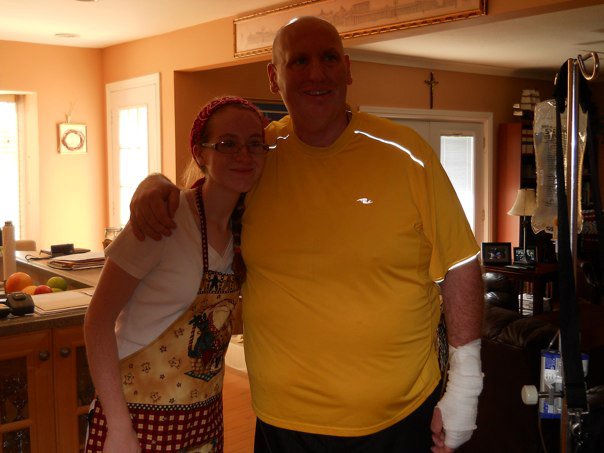

Interdependence is a fundamental aspect of the human condition. A loss of autonomy–whether temporary or permanent–does not mean a loss of dignity, and it is grossly ableist to suggest the opposite. When we demonize dependency, we demonize our very humanity.
Let us bless the vulnerability and poverty in the face of the Other. We can start by looking in the mirror.
-
You’re not a mistake.

The apples we place in our grocery carts are all perfectly round. Each red rose in the bouquet from our local florist is the same size and the same shade as her companions. When we don’t spend much time in uncultivated nature, we sometimes end up thinking that plants always look so similar to each other.
But then, Nature stuns us with her variety. Crooked purple carrots push up through the soil, knobbly yellow apples fall from the trees, and asymmetrical roses blossom.
This one probably won’t end up at your florist’s shop. But are her differences a flaw–or part of her unique beauty?
If you’re anything like me, maybe you’ve caught yourself in this kind of thinking pattern: “I wish I had her looks. I wish I had as many degrees as him. I wish I had their kind of marriage. I wish…”“God, why did You make me like this? God, why did You put me on this path, and not that one?”
It is OK–more than OK– to grieve if your life doesn’t look the way you wished it did. Let’s also remember, though, that we’re the children of an infinitely creative God, and His glory manifests itself in an infinite number of ways. Is it possible that your unique self and unique plan is a blessing to be embraced, not a flaw to be fixed?
We all have to grow in sanctity. But sanctification means God pruning us and nourishing our soil–not replacing us with a “different plant”.
God didn’t have to create you. So if you exist, in all your unique glory, it’s because He wants you to be here.This short reflection was written for my friend Magda’s blog/ministry, Girlfriend Restored. Check out her reflections and resources for those affected by betrayal trauma at girlfriendrestored.com
-
Poetry Rx

Dear patient,
Your prognosis is unclear. The treatment journey for your chronic illness will be complex. As a start, please add in iron supplements, to improve your energy levels. I am also prescribing some poetry, to fortify your spirit.
These “prescriptions” are actually, in the main, descriptions. They are not curative; rather, they will anchor and organize your thoughts. But you will discover the value of a vivid word-anchor, on the days when your mind is tempest-tossed by appointments and needles and waitlists and specialists and the unsolicited medical advice of strangers.
For When You Want to Shout at God for Answers
‘My nerves are bad tonight. Yes, bad. Stay with me.
Speak to me. Why do you never speak. Speak.
What are you thinking of? What thinking? What?
I never know what you are thinking. Think.’
– The Waste Land, TS Eliot
For When Shouting at God Feels Pointless
Ay me, to whom shall I my case complaine,
That may compassion my impatient griefe!
…To heavens? Ah! they, alas! the authors were,
And workers of my unremedied woe:
For they foresee what to us happens here,
And they foresaw, yet suffred this be so.
– The Dolefull Lay of Clorinda, Mary Sidney Herbert
For When You Just Want Your Old Life Back
“But those two circles, above all the point at which they touched, are the very thing I am mourning for, homesick for, famished for. You tell me ‘she goes on.’ But my heart and body are crying out, come back, come back. Be a circle, touching my circle on the plane of Nature. But I know this is impossible. I know that the thing I want is exactly the thing I can never get.”
– A Grief Observed, CS Lewis
For When You Grieve the Healthy Future You Thought You’d Have
Footfalls echo in the memory
Down the passage which we did not take
Towards the door we never opened
Into the rose-garden. My words echo
Thus, in your mind.
But to what purpose
Disturbing the dust on a bowl of rose-leaves
I do not know.
– Four Quartets, TS Eliot
For When You Know, Bone-Deep, the Etymology of “Patient”
I have given my name and my day-clothes up to the nurses
And my history to the anesthetist and my body to surgeons.
…My body is a pebble to them, they tend it as water
Tends to the pebbles it must run over, smoothing them gently.
They bring me numbness in their bright needles, they bring me sleep.
– Tulips, Sylvia Plath
For When You Feel Useless to the King and Kingdom
“Doth God exact day-labour, light denied?”
I fondly ask. But patience, to prevent
That murmur, soon replies, “God doth not need
Either man’s work or his own gifts; who best
Bear his mild yoke, they serve him best. His state
Is Kingly. Thousands at his bidding speed
And post o’er Land and Ocean without rest:
They also serve who only stand and wait.”
– Sonnet 19: When I consider how my light is spent, John Milton
For the Waves of Pain Before the Anesthesia Kicks In
For When You Need the Motherly Mystics
Let nothing disturb you,
Let nothing frighten you,
All things are passing away:
God never changes.
Patience obtains all things
Whoever has God lacks nothing;
God alone suffices.
– St. Teresa of Avila
For Every Moment of This Journey
Let everything happen to you: beauty and terror.
Just keep going. No feeling is final.– Go to the Limits of Your Longing, Rainer Maria Rilke
-
What is the duty of the living?

Retired Cpl. Christine Gauthier had been trying for 5 years to get Veterans Affairs Canada to install a wheelchair ramp at her house. The former Paralympian was speaking yet again with the VAC, describing the disability-related challenges she was facing. Eventually, an employee suggested that if life was becoming so difficult for her, perhaps she would prefer receiving physician-assisted suicide? They could even supply her with the MAID “equipment”.
Gauthier said of the encounter, “I was completely shocked and in despair.”
Another Canadian veteran reached out to Veterans Affairs, looking for mental health support. The caseworker instead repeatedly offered the man assisted suicide, despite the fact that the veteran had never asked for it. He reported that his VAC caseworker said to him, “Oh by the way, if you have suicidal thoughts, [MAID is] better than blowing your brains out against the wall.”
A much cleaner solution. Maybe that’s why they use the euphemism “MAID.”
Although the gentleman had been in a good place prior to the call, he was so shocked afterwards that he left the country. It’s a phenomenon known as “sanctuary trauma,” where a person is left immeasurably harmed by the very people he thought would help him.
Speaking of sanctuary, have you heard of the latest bold solution to the problem of homelessness? Apparently, nearly a third of Canadians from a variety of demographics support MAID for those who are homeless. The message is loud and clear: if you can’t afford a house, we can give you a body bag.
How quickly the so-called “right to die” becomes a duty to die. And how easy it is for a vulnerable person to believe the lie that she should erase herself if her needs take up “too much space” in the community.
The slope is indeed slippery, friends. And another word for a slope that’s approaching ninety degrees is cliff.
It would be easy to turn a blind eye to the medicalized executions happening in our midst. But I propose to you that instead, we be our brother’s keeper, and his lifeline. We cannot abandon him in his moments of crisis and confusion. We have to help him remember his reasons to stay when dark voices whisper the reasons he ought to go.
And the best way to honor those already lost is to make sure that no more victims are added to the body-count. As Lois McMaster Bujold has written, “The dead cannot cry out for justice. It is a duty of the living to do so for them.”
If you are struggling with suicidal ideation, please know that you are not alone. You can find crisis support resources here. You are irreplaceable, and deeply loved. You deserve to be here.
To take action against the expansion of euthanasia in Canada, visit Care Not Kill.

Pro-life speaker & activist. Poet. I also write on disability, theology, literature, & more.

