-
“Lives Lived For Life” Magazine
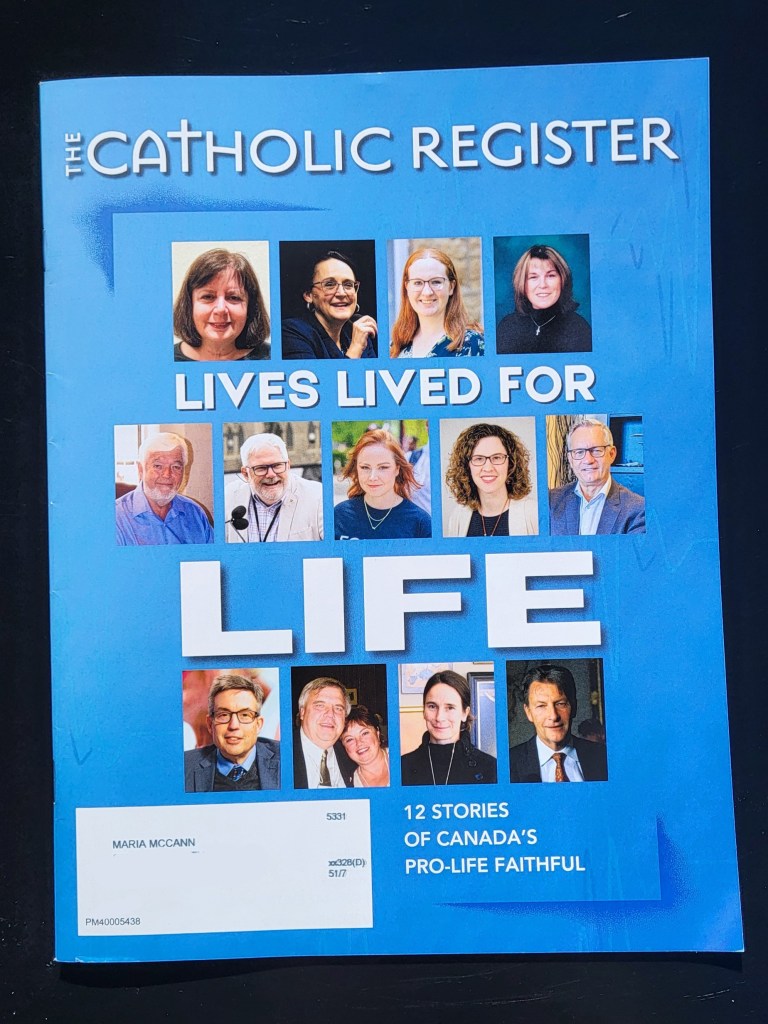
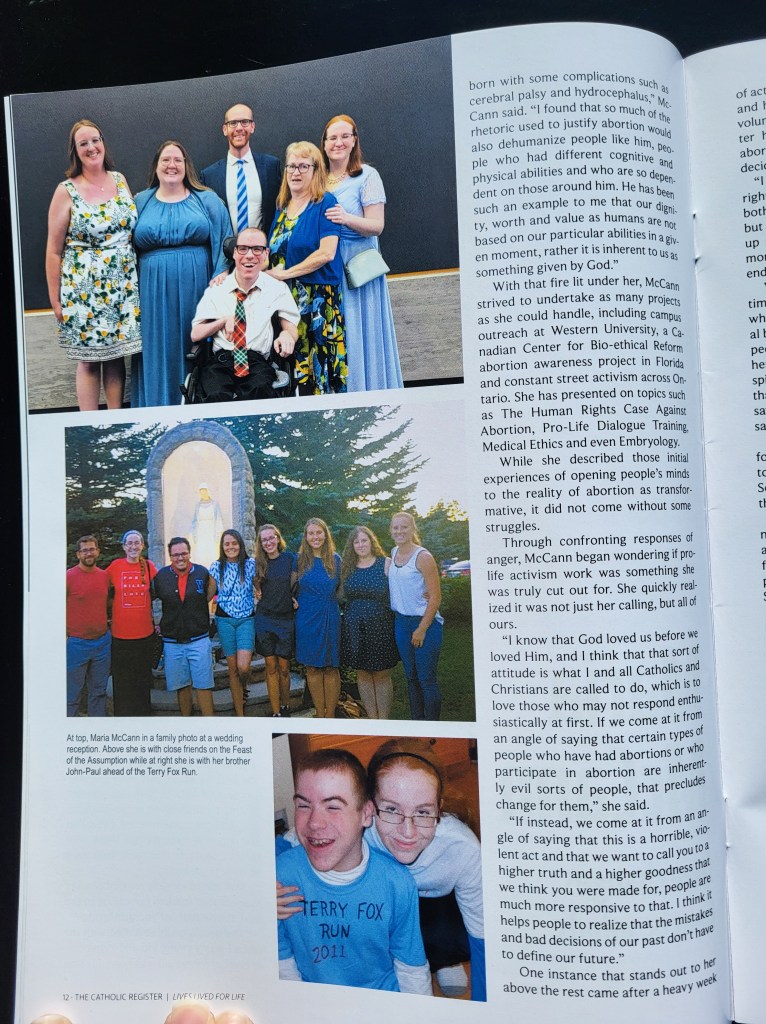
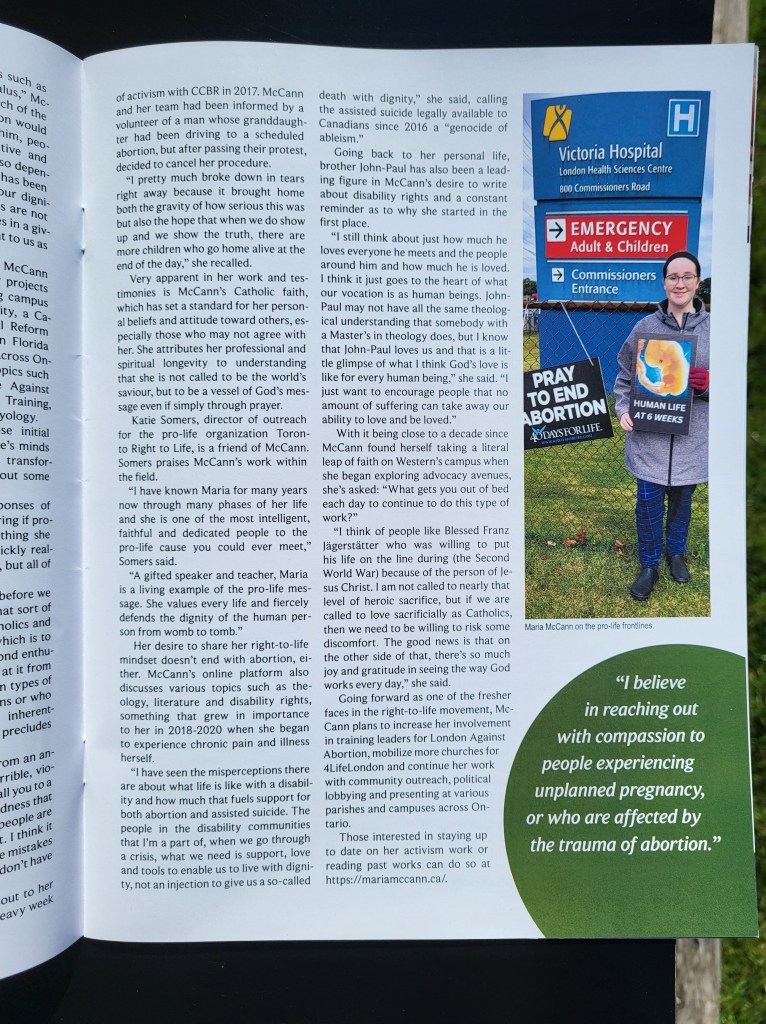
Earlier this year, I was interviewed by the Catholic Register about my involvement in the pro-life movement. I was overwhelmed and humbled to be included in their “Lives Lived For Life” issue, a special edition which highlighted 12 stories of pro-life Canadians.
My prayer is that anyone who reads the issue realizes that every one of us has a role to play in ending abortion. The pro-life movement is not about me or about you. It’s about our pre-born neighbours, little girls and boys, whom God calls us to protect from slaughter.
Get Involved: EndTheKilling.ca/TakeAction
I’m so grateful for the support of my family in doing this work, and for the countless pro-life colleagues who’ve become a second family.
Soli Deo honor et gloria!

-
Valued and Loved
CW: Brief description of intimate partner violence
“I don’t want to play God and decide who lives and who dies,” Helen said reluctantly. Nevertheless, she still thought that abortion was needed in many difficult circumstances. If a woman felt unready, or was battling poverty, how could she care for the child? She spoke at length of her concern for women and girls in bad situations, and I did my best to listen intently. “I agree with you that getting pregnant when you’re in a bad situation would be really scary,” I said to her. “A woman facing that definitely needs our help. Imagine with me, though, that there’s a woman who during pregnancy is in a good situation. Her finances are stable, and her partner is supportive. But after she gives birth, things change–she suddenly loses her job, and her partner walks out on her.”
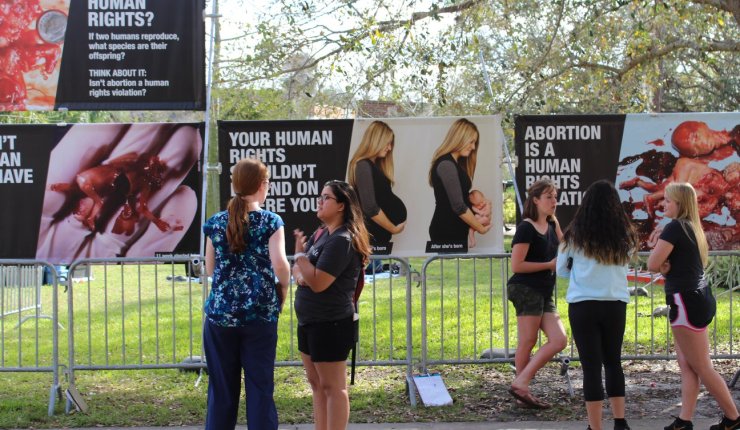
I paused, then asked: “Would it be OK for her to kill her newborn baby, because she’s facing so many difficulties?” “Of course not,” Helen answered. “I agree,” I said. “So, if it wouldn’t be OK to kill a born child because the mom is facing so many difficulties, why would it be OK to kill a pre-born child for the same reason?” Behind me, on our signs, were photos of the broken bodies of aborted children.
Helen thought about this, and then gave voice to the painful memories that fuelled her support for abortion. “My mother was horribly abused and beaten while she was pregnant with me,” she told me. “And she was very poor. She should have just gotten an abortion. Things would have gone better, and been easier for her.”
In a few short sentences, she conveyed layers of trauma. Her mother was a survivor of assault, and so was she. The abuser had treated both women like worthless trash.
Many people can have a hard time valuing pre-born children if they don’t first know their own value. I wanted Helen to know the truth: that she and her mom were precious and worthy of care.
“I’m so sorry your mom went through that,” I said to her. “That should have never happened to her. If you don’t mind me asking, is she safe? Is the abuser still in her life?” Thankfully, her mom had escaped the situation, but had then endured great poverty. Helen truly believed that it would have been better if her mother had aborted her.
“Do you think your mom feels the same way?” I asked gently. “Do you think she wishes she’d had an abortion?” I was prepared for the response to be Yes, because I have met people whose parents have said just that. I was glad that Yes was not the answer given. “No, she would never say that,” Helen immediately replied. “She would say that she would go back and choose me all over again.” I asked some more questions about Helen’s story, and she told me that she was now caring for her aging mom.
“Leaving aside abortion for a moment”, I said, “I just want to emphasize that it really sounds like your mom’s life is actually better for having you in it. She loves you, and you love her, and she knows that you love her. And you’re helping to care for her now. There are so many people who wish they had that kind of love in their life. So I just want to emphasize that her life is better with you in it, and I don’t think we should assume that her life would have been better without you.”
Something shifted in the tone of our conversation, at that point; she seemed moved, and became more open to the pro-life perspective.
Our value as humans is not contingent on whether other people love us, but it can be incredibly hard to know our own worth until we have experienced the love of other people–and ultimately, the love of God.
Man cannot live without love. He remains a being that is incomprehensible for himself, his life is senseless, if love is not revealed to him, if he does not encounter love, if he does not experience it and make it his own, if he does not participate intimately in it.
Pope St. John Paul II, REDEMPTOR HOMINISHelen and I went on to discuss many other aspects of the abortion debate, such as whether pre-born children were equally valuable to born children. We talked about the legal and cultural shifts needed to protect the pre-born and support women and girls. Helen spoke with conviction about how important it is for a man to step up and support his partner during pregnancy, rather than pressuring her to have an abortion just so he can evade the responsibility of fatherhood.
As outreach was ending, I asked Helen, “Thinking about abortion in light of what we’ve discussed, do you think there’s any situation where it’s OK?” She thought about this question, then told me that she was still unsure about cases where the woman’s life was in danger or the baby had a terminal illness. I encouraged her to keep thinking about the issue, since abortion profoundly affected so many people. We shook hands and I thanked her for stopping to speak with me.
-
Taxi Rides, Disability, and Unexpected Grace

I had an unexpected and beautiful encounter with my cab driver today in Toronto. He called me because he was having difficulty stopping at my location, and he asked if I could walk to another place nearby. I nervously replied that I couldn’t because of my disability. (My hips and back were aching, making walking difficult.) Rather than being annoyed, he was instantly understanding and said he would come right to my spot.
It was, indeed, not a great stop because it was so close to a ramp to the Don Valley Parkway. As he pulled over, a large truck behind him honked angrily. He got out of his car to help me with my luggage, and shouted at the truck drivers, “She has a disability!” (Had I been a turtle in that moment, my head would have retracted into my shell.) He motioned for them to roll down their window, and told them that he had to stop there in order to accommodate me.
I felt nervous and sheepish. Was his shouting at them a sign that he was annoyed with me? I got into the cab, offered my apologies for the trouble, and settled in for the drive.
After a couple of minutes, he said to me, “Can I ask you a question?” I braced myself to be asked why I didn’t have some sort of mobility device with me to signal that I was disabled. Instead, he opened up and told me that his younger brother in his native country had a cognitive disability and needed a lot of care. He was working as hard as he could to bring his brother over to Canada. “I want to have him with me for the rest of my life,” he said, with conviction in his voice.
He asked me what sort of supports, if any, were available in Ontario for people with disabilities. I told him that although the system was far from perfect, there were many supports. I explained a bit about ODSP and the medical process to get it, some social services for people with different challenges, and so on. I added in that the process to attain those supports would take longer for someone immigrating to Canada, and we talked about the steps he himself had taken to come here. I was taken aback when he said that he was so thankful to have me as a rider, because he didn’t know anyone to talk to about his situation, and he desperately wanted to provide the best care for his brother. He found it more helpful, he said, to speak with people who had personal experience navigating the system, rather than only talking with people in bureaucracy. He said that I had given him more hope for the future, because now he knew that there were resources available to help his brother.
I asked him a bit about his brother, and he explained the challenges that the young man faced. He said that everyone needs a reason to live for, and a major reason for him was his relationship with his brother. He first emphasized the importance of duty to one’s family. Then, he went on to talk about how, when we sacrifice out of love for others, our lives paradoxically becomes enriched rather than diminished. I was so encouraged by his love for his brother, and told him a bit about my own younger brother and his complex medical needs. (My brother has faced massive challenges throughout his entire life, and yet has the most joyful spirit of anyone I know.) The driver and I talked about how everyone benefits when we work to build a more inclusive society for people of all abilities.
Our culture frequently criticizes toxic expressions of masculinity, and those expressions certainly exist. I think we also need to remember, though, that if toxic masculinity is so ugly and repulsive, that simply shows that authentic masculinity is supposed to be beautiful and inspiring. I saw that expression of true masculinity in my driver today. He was willing to firmly stand up for my need for accessibility, even though it irritated people around him. He was committed to loving the most vulnerable people in his life, and he perceived the mystery that it is in giving that we receive.
-
“Shouldn’t we talk more about adoption?”
I recently gave a pro-life presentation on how to have effective conversations about abortion. The talk focused on discussing science and human rights with pro-choice people, to help them understand that abortion is a human rights violation against an innocent child.
During the Q&A session, a participant asked me a question that I’ve heard often from pro-lifers: “Shouldn’t we be talking more about adoption? There are long waiting lists of couples wanting to adopt children.” I could see where he was coming from. After all, if a woman is pregnant but does not feel prepared to care for a new child, isn’t adoption a solution to her situation, and a way to bless another couple with the gift of a child? Shouldn’t we then recommend that, in our conversations with abortion supporters?
“That’s a great question,” I said to him. “There are definitely times and situations when it is appropriate to discuss adoption in our conversations about abortion. However, I almost never bring it up early in the conversation with a pro-choice person–for two reasons.”
“First of all,” I said, “By jumping to promoting adoption, we accidentally end up sidestepping the question of whether abortion is moral or not. For instance, imagine that World War III broke out tomorrow and adoption was suddenly impossible in Canada. Would abortion suddenly become OK, just because there are no adoptive parents available? I would say absolutely not, because abortion still kills an innocent child.”
And my analogy is not far-fetched; that kind of situation could easily happen to people who are fleeing a violent country, for instance. What if they spend months in a refugee camp, and cannot find anyone to adopt their 2-year-old child? Would it be okay for them to kill their toddler due to the lack of adoptive parents? Most sane people would answer, Of course not. But if it wouldn’t be okay to kill a born child, even if there are no adoptive parents for him, then why would it be okay to kill a pre-born baby for the very same reason? But that’s different, the pro-choice person may answer. It’s not a human yet. We must then return to the central question of the abortion debate: who are the pre-born? Are they living human beings, deserving of equal rights?
I continued, “The second reason that I avoid discussing adoption, at least early in the conversation, is because of a common negative perception of adoption by many pro-choice people. Many pro-choice people actually view adoption as worse than either abortion or parenting.”
The thought process of the pro-choicer goes something like this: while abortion is undoubtedly difficult for a woman to go through, it at least “solves” the problem of her unwanted pregnancy by ending the pregnancy. She can avoid having her life irrevocably altered by an infant. If she chooses to carry to term and parent, then she does deal with the difficulties of pregnancy and an altered life trajectory, but she will hopefully experience love and connection with her newborn baby.
When many pro-choice people consider adoption, they view it as the worst option, because not only does the woman go through the difficulties of pregnancy, but she also will bond emotionally to the baby. Adoption will then inflict a wound of separation on her and her baby. I’ve heard many pro-choice people say that the woman could spend her whole life wondering how her child is doing, and the child could spend his whole life feeling abandoned or unwanted. (Some people also mistakenly conflate the newborn adoption system with the foster care system, and worry that the child could go for years without a permanent adoptive family.)
There are some untruths mixed in with all three of these views. I have met countless women and men who discovered that abortion was not an easy and painless choice, but instead led to deep grief and regret. It did not prevent them from becoming parents–it simply made them the parents of a dead child. Improved adoption systems can help biological parents to connect or re-connect with their children, when it is possible and appropriate to do so. And I have dear friends who are adopted, who lead lives filled with love and purpose. The late Steve Jobs was adopted, and spoke of his gratitude for his birth mom’s courage: “I wanted to meet my biological mother mostly to see if she was okay and to thank her, because I’m glad I didn’t end up as an abortion. She was 23 and went through a lot to have me.”
However, even if the pro-choice assumptions are all correct–even if abortion involves the least emotional pain for the mother, and adoption involves the most pain–this still would not justify the violence of abortion, any more than it would justify killing a one-year-old child.
So, I said to this gentleman that I thought it would be more effective to first talk with a pro-choice person about why abortion is an injustice, and should not even be an option on the table. Once we’ve reached a consensus on that, then we can have compassionate discussions about how to best care for the child, and whether adoption is an appropriate route to pursue. My lovely friend Gabrielle, an adopted person herself, put it succinctly:
“The moral issue of abortion is cut and dried, but the social issue of unplanned pregnancy is not.”
On that note, pro-life people also should acknowledge that placing a child for adoption will involve pain for all parties involved–the biological parents, the adoptive parents, and the child. If we simply respond, “But she can just put the baby up for adoption!”, the pro-choice person will likely think that we are (at best) naïve to the traumas that can accompany the adoption process. We don’t want to give the false impression that adoption is “magical fairy dust” that we can sprinkle on an unplanned pregnancy, to “fix” the situation for everyone involved. Gabrielle has spoken openly to me about her experiences with adoption, both the blessings and the hardships. She emphasized to me that while she is deeply grateful for her life and her family, she also faces challenging questions about her identity, her origin story, and her family relationships. We can defend the human rights of pre-born children, without ignoring the complexities of adoption.
A final word of caution, when we are speaking about adoption: some people talk about adoption as important because it can allow infertile couples to raise children. This well-intentioned statement unfortunately glosses over the painful realities of infertility, which cannot simply be “fixed” by adopting a baby. Gabrielle told me that this viewpoint also pains her, because it treats adopted children as commodities, as “solutions” to a problem, rather than as people deserving of love. Adoption should always prioritize fulfilling a child’s need for (and right to) a loving family, not fulfilling the desires of adults for children.
What do you think? How have discussions about adoption played into your conversations about abortion?
This article was also published in Dutch for the organization Kies Leven: https://kiesleven.nl/zouden-we-het-niet-vaker-over-adoptie-moeten-hebben/
-
Lobbying for Paratransit Reform
Yesterday, I had the opportunity to speak briefly at a London City Council meeting. I talked about the challenges I have faced while using the London paratransit system, and shared some ideas for improvement. Paratransit has been in the local news frequently (e.g. here, here, and here) for posing problems to its users, and the disability community in London has been very vocal on the issue.
Check it out:
-
Welcome to my blog!

Hello, and welcome to my blog!
My name is Maria, and I live in Ontario, Canada. I am a Catholic woman, a daughter, a sister, a #CoolAunt, and a friend. I am also a pro-life public speaker–you can read more about that here.
In this space, I hope to share my reflections on social issues, such as the abortion debate, disability rights advocacy, and other matters of human dignity and flourishing.
I have lived with chronic pain for about 7 years. Developing chronic pain in your early twenties is not the future anyone prepares for, and the challenges of my disability have sometimes been extreme. I am fortunate to have a web of family and friends who have supported me in the most intense trials. I hope that by writing about my experience with chronic pain and with the medical system, I can process some of those experiences for myself, and help other people in similar situations to feel less isolated and more empowered.
Besides social advocacy, I am also deeply passionate about literature, philosophy, and theology. I am always looking for ways to dive deeper into these subjects and grapple with their complexities. I want to pursue the Good, the True, and the Beautiful.
If you want to read more and join the conversation, subscribe to receive future blog posts!
-
The Truth is a Light in the Darkness

Originally posted on November 16th, 2020 for the Canadian Centre for Bio-Ethical Reform
“A crowd flowed over London Bridge, so many,
I had not thought death had undone so many.
Sighs, short and infrequent, were exhaled,
And each man fixed his eyes before his feet.”These lines from T.S. Eliot’s 1922 poem The Waste Land have long haunted me, especially in the context of the abortion debate.
Could Eliot somehow see into the future and visualize what a “Choice” Chain looks like? Of course not, my rational side thinks; he was simply speaking about the terrible social isolation he was witnessing in his own time. Suffering and loneliness and the impact of death are by no means new phenomena. Nevertheless, I have been reminded of his words many times when I have gone out to do activism.
The parallels are almost eerie. As we stand on street corners for “Choice” Chain, crowds of people will mill past, their eyes usually cast downward towards their cellphones. And when they do look up — often startled, understandably, by the unusual question “What do you think about abortion?” — their apathy often suddenly transforms into anger, which often masks underlying grief. I have lost count of the number of post-abortive people that I have met in the 5 years that I have been involved with CCBR. Millions of tiny corpses do not simply disappear in a vapour cloud of ‘choice’; a scarred society is left behind. Death has undone so many.
And yet, there is so much reason for hope. I have heard it said that it is better to light a candle than to curse the darkness. I agree with the sentiment, but the wonderful thing is that the truth isn’t just a faint candle. The truth is a roaring fire, dispelling both the shadow of death and the chill of empty ideologies.
I remember speaking, for instance, with a young woman named Olga, several summers ago in Toronto. She stopped because she was curious about our signs and our views, but she supported abortion and said that she was not sure what she herself would do in an unplanned pregnancy situation. She especially thought that abortion was needed to prevent future suffering for the child. I spoke with her at length, but nothing seemed to get through and she remained obstinately pro-choice.
Unsure how to continue the conversation, I tentatively shared with her what I had learned from philosopher Viktor Frankl about suffering. I told her that suffering did not have to lead to despair, because although we will all suffer at some point, it is possible to find meaning in even the darkest situations. That was the proverbial “light bulb” moment for Olga. She responded with passionate agreement, and we talked about how we would both try to help people find meaning in the face of immense suffering. We talked about the importance of preventing lethal choices like suicide as a response to suffering. Olga then made the connection that abortion, like suicide, was a tragedy rather than a solution. Before leaving, she said to me, “You’ve definitely pushed me towards the pro-life end of the scale. I’ll never get an abortion. There’s always another way.” When she considered a philosophy built on hope rather than despair, her heart changed and softened towards the pre-born baby.
Eliot’s poem The Waste Land is a long, grim survey of a 1920s world reeling from recent war. As the title suggests, the very earth itself seems to cry out in anguish. Nevertheless, the speaker in the poem takes a hopeful turn towards the end, when he notes that rain is coming to revive the arid landscape. Faint hope further lies in the speaker’s concluding thoughts: These fragments I have shored against my ruins. Stories, flickers of light here and there, are enough to at least provide him with hope. And I think of the testimonies like that sometimes. The darkness of abortion can be overwhelming—death has undone so many—but my mind is also filled with story after story of people whom I have seen, before my own eyes, go from supporting abortion to rejecting it. The testimonies are fragments of hope and healing to shore against a crumbling culture.
However, I have even firmer reasons for hope. A plethora of anecdotes is not data. Stories by themselves are not enough. We need firm evidence that our work is changing the culture, and saving children. But we have the data – the hard numbers that show that simply seeing abortion victim photography changes people’s perceptions of abortion. The testimonies are then merely reflections of those stats; stories are ‘data with a soul’, as researcher Brené Brown puts it.
And I have a firmer reason still for hope in the face of abortion and all the shadows of this world. It’s a hope that eluded Eliot at the time of his writing The Waste Land, but one that he eventually embraced in his conversion to Christianity later in life. We grieve at the deaths of countless children, but we do not grieve like those who have no hope. Death does not have the final say. When the light shines in the darkness, the darkness does not overcome it.
-
Speaking with Survivors
Originally posted on April 27th, 2020 for the Canadian Centre for Bio-Ethical Reform
It is a question that you will be asked in nearly every conversation about abortion. What about when a pregnancy has resulted from a heinous act of violence? What about pregnancy in the case of sexual assault? Abortion supporters often ask this question in a hypothetical sense, and we should be able to provide a compassionate and logical answer about why we need to protect both the mother and the baby. Some people, however, are not thinking of a hypothetical situation, but instead of an all-too-real memory.
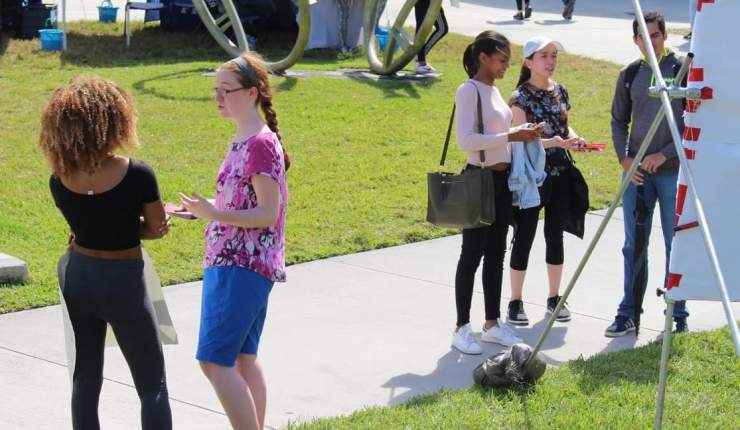
I remember speaking with Alex* some time ago during a college “Choice” Chain. She disclosed her experience at the very beginning of our conversation: “I get that you guys are pro-life and stuff, but what about rape? I was raped when I was a teenager. Do you think that even in situations like mine, women still shouldn’t have abortions?”
When someone discloses a traumatic experience, there is no blueprint for the “perfect” response. I think that we can, however, take guidance from authors Mary Schaller & John Crilly. In their book The 9 Arts of Spiritual Conversations, they write, “Asking questions from genuine interest builds connection. Connection builds trust. Trust is the bridge that can bear the weight of truth.”
The first thing that I said to Alex was, “I’m so sorry that that happened to you. I want to answer your question but first, I just have a question for you. Are you safe? Is the person who hurt you still in your life?” Alex told me that the assault had happened a few years ago, and the perpetrator was thankfully no longer in her life. (If the assault had been more recent, it may have also been appropriate to ask her if she had reported the assault, or wanted to.) I asked her if she had people in her life who were supporting her in her healing journey, and she mentioned that there were people such as her mom who were helping her.
I continued asking questions as gently as I could, and I focused on really listening to Alex. She shared her story of being sexually abused in high school, and the eating disorder she had developed as a result of trying to cope with her trauma. I affirmed her value and emphasized that what had happened to her was not okay.
At one point she said to me, “What about women who are walking by who may have had abortions? How do you think these photos would make them feel?” I replied to her, “I agree with you that there may be women walking by right now who have had abortions, and seeing these photos would be really difficult for them. But the reason we are here is not to condemn people for the choices they’ve made in the past. We are here to offer information to help people make better choices in the future.” I pointed down at my sign at one point and said to her, “I refuse to believe that this is the best we can do for women and their children.”
We continued talking and a little while later she said to me, “I know that you’re not here to judge women who’ve had abortions.” She then disclosed to me that she had become pregnant as a result of the assault, and had had an abortion.
Again, I asked her gentle questions about her abortion and what she thought about it now. I told her how sorry I was for everything she had gone through. We found common ground by agreeing that society needed to do more to support women and their children.
Alex told me that she didn’t like to think about the abortion much because it was in the past, and she didn’t want to have regrets about the past. I then shared the Choice42 website with her and told her about the groups that exist for people who seek healing after abortion. “Maybe this resource won’t be useful to you today or tomorrow,” I said to her, “but maybe you could find that useful sometime in the future.”
Alex agreed with me and accepted the resource card, and she asked me more questions about why we were against abortion. And I didn’t shy away from those questions. I continued to share the truth with her about the humanity of the pre-born and the inhumanity of abortion. Because as my friend Devorah has often said, truth without love is ineffective — but love without truth is a lie. We need to share both.
By the end of our long conversation, Alex still identified as pro-choice. However, she had seen the truth, had heard the truth, and had heard that there was the possibility of healing and forgiveness after abortion. And I was so grateful when she said to me, “You’re starting to sway me. You’ve definitely opened my mind. When should a human being get human rights? That’s not something I’d ever thought about before.”
*Name changed to protect privacy
-
What About a Woman’s Right to Choose?

Originally posted on November 1st, 2018 for the Canadian Centre for Bio-Ethical Reform
While at a pro-life display with Toronto Against Abortion, I asked a young woman what she thought about abortion. The student, Sharon, told me that she was pro-choice. “Is there any particular reason that you’re pro-choice?” I asked, for clarification. Sharon said, “I think that it’s important for women to have a choice about having a child. Especially if they weren’t planning on getting pregnant.” She told me that she was not sure what she herself would do in an unexpected pregnancy.
Many people will bring up difficult circumstances, such as suffering or cultural pressure, to justify abortion; however, it is even more common for people to bring up the right to choice and bodily autonomy as the justifying factors. Abortion supporters typically brand themselves not as “pro-abortion” but as “pro-choice.” As pro-life advocates, we need to show people that our right to bodily autonomy does not include the right to harm or kill others.
“I would agree with you that the right to choices is important–especially choices about our own bodies,” I said to Sharon. “I think, for instance, that you and I should have the right to go to a bar and drink, even if drinking isn’t very healthy.” She nodded in agreement. “Imagine though,” I continued, “that after having a few drinks, I then get behind the wheel of my car. Would you still support my choice?”
“No, of course not,” she answered. “Why not?” I asked. “Well, because then you could harm other people.” “Yes,” I answered, “you wouldn’t support that choice–not because you don’t respect me, but precisely because you value other people’s safety.” I then pointed to the bloody 10-week aborted child in my pamphlet, and asked her, “So what about this choice? Doesn’t abortion harm another human being?”
Sharon thought about this question and looked at the photo. She then told me that later in pregnancy, the fetus seemed really developed and human, but abortion should still be acceptable earlier in pregnancy. “Earlier on, aren’t they not very developed?” she asked me.
We then discussed embryonic development as we looked at photos of first-trimester children — some healthy and alive, some dismembered by abortion. I shared with her some embryology facts, such as the child’s brain waves being detectable just after 6 weeks, and her heartbeat beginning at just 3 weeks. We continued talking about level of development and whether it should impact our human rights. She eventually agreed that human rights should begin as soon as a human being’s life begins–at fertilization.
To close the conversation, I asked Sharon if she still thought that abortion should be acceptable at any point in pregnancy. She replied, “When I came over here I was thinking about how important it is for a woman to have the choice. But I believe even more strongly that the baby shouldn’t be punished–nothing should be done to the baby.” I then emphasized to her the importance of supporting women during challenging pregnancies, as so many women entered abortion clinics precisely because they felt like they had no other choice. Sharon shook my hand, and although she had been pro-choice just 15 minutes earlier, she left our conversation completely pro-life.
-
When Does Life Begin?

Originally posted on November 27th, 2018 for the Canadian Centre for Bio-Ethical Reform
As I was reading Maaike Rosendal’s new article about in vitro fertilization (IVF), it reminded me of a recent conversation I had with a student during “Choice” Chain. IVF has many troubling ethical implications, and I encourage you to read the article in order to understand how it harms and even kills many pre-born children. Discussing IVF can, however, help pro-lifers to show skeptical people an important truth: we know when human life begins.
I asked a student at York University what he thought about abortion, and offered him a pamphlet. Abdul stopped and started looking at the pamphlet, and told me that he didn’t have a strong opinion on abortion. He listed a couple of arguments from pro-choice and pro-life perspectives, and said that he wasn’t sure which side to believe. We discussed human rights, and he agreed that human rights should be for every human being. As we looked at the 7-week embryo on the pamphlet, he was surprised by how developed she was: “That sure looks like a human. Yeah, that looks like a person.”
I drew Abdul’s attention to the other photos of children aborted in the first-trimester, and I asked him what he thought about those photos. He told me that he now agreed that abortion from 7 or 8 weeks onward was wrong, because the child looked so developed. “I’m glad that we can agree that a huge percentage of abortions aren’t okay,” I said to him. “Why do you think that abortions are okay earlier than 7 weeks, though? Shouldn’t human rights begin when a human being’s life begins?” Abdul told me that he didn’t think that there is a full human being right at fertilization, because the zygote is a single cell and is so much less developed than 7 or 8 week embryos.
I said to him, “Let’s set aside for a moment the question of abortion and whether it ends a life. Let’s look at when we want to create a new human life. If I wanted to create a new human life, outside of the normal means of people having sex, what process would I replicate in a lab? Would I do in-vitro…heartbeat? Or in-vitro brainwaves?”
“No,” he said, “You’d do in-vitro fertilization.”
“And why is that?” I asked.
He answered, “Because that’s when everything begins…Oh wait, I see what you mean!”
It was just the ‘lightbulb’ moment that I hoped he would have.
We were going to continue the conversation, but Abdul realized that he was late for his class. We shook hands and he rushed off, pamphlet in hand. While I was not able to confirm whether he left completely pro-life, I know that he left with a new understanding of the humanity of even the tiniest embryo.
-
Are Human Rights for all Humans?
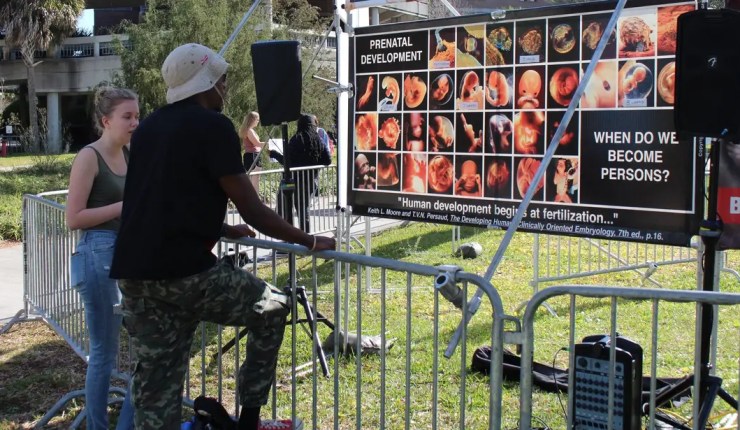
Originally posted on October 15th, 2018 for the Canadian Centre for Bio-Ethical Reform
Alex had stopped, curious at our images and at my question— “What do you think about abortion?”—as he was heading to class.
“I’m pro-choice,” he answered.
“Pro-choice for what?” I asked.
“Uh, just pro-choice. I’m not sure what you mean.”
“Sorry,” I replied, “I don’t mean to be confusing. I’ve talked to a few people today who said they were pro-choice, but they all had different definitions of it. What does being pro-choice mean to you?”
We chatted for a couple minutes and he gave me some reasons why he supported abortion. I then asked him, “Do you believe in human rights?”
“Yes,” he replied.
“Great, me too! And who should get human rights?” I continued.
He became thoughtful—which is a great thing. We want people to consider their views more carefully! “Hmm…I think that humans who are rational and self-aware should get human rights.”
Though he did not explicitly use the word “personhood”, I realized that Alex was basically making a distinction between “persons” and human beings. I have heard people cite countless different standards which they believe a human being must meet in order to attain personhood. But these philosophical claims need not intimidate us. We can ask simple questions to help people understand that this distinction flies in the face of human equality. And “ask questions” is exactly what I did.
“I’d agree that our rationality is one of the things that makes humans special,” I replied. “I’m not sure though that it’s the reason we get human rights. Think of it this way: imagine there’s a man who’s in a temporary coma—for, say, 9 months. The doctor tells you that for those 9 months the man will be totally unconscious, but he’ll regain consciousness afterwards. Would it be OK to kill him during those 9 months, since he’s not self-aware?”
He considered this and said, “No, that’s a good point. I guess it’s more about whether or not a person is going to be happy and functional.”
I offered another analogy and question to challenge this: “Well, imagine that tomorrow, the unthinkable happens: you get into a car crash with some family members. Some of them die, and you become a paraplegic. You wouldn’t be very happy, and you wouldn’t be as functional, right? But wouldn’t you still get human rights?”
He considered the scenario and again replied, “Yeah, I don’t like that definition either.” I gave him a couple moments to process his own thoughts. I then asked him, “Isn’t it most philosophically consistent to say that all humans should get human rights?”
“Yeah, I guess so,” he answered. Then he asked me, “So why are you here showing pictures of aborted fetuses?”
I knew that it was then a good time to make the case for human equality. “I’m here because throughout history, humans have been denied human rights and personhood for so many reasons. People have been lethally discriminated against because of their race, or gender, or their sexual orientation. Today, in Canada, an entire class of human beings are denied rights and personhood because of their age–because they’re living in the first 9 months of life.”
He looked at our photos of tiny aborted children and said, “Yeah—all the arguments go back to their age.”He was silent again and then said to me, “Well, if your goal was to get me thinking, you’ve definitely succeeded.”
He took a pamphlet, shook my hand, and thanked me for the conversation before continuing to his class.

Pro-life speaker & activist. Poet. I also write on disability, theology, literature, & more.

