-
“Lives Lived For Life” Magazine
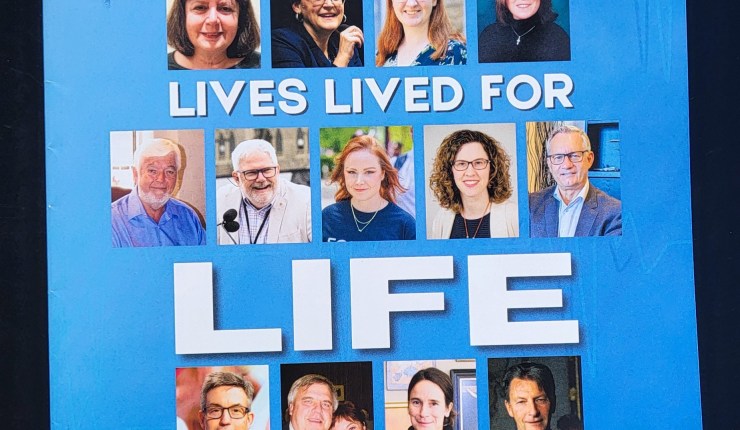
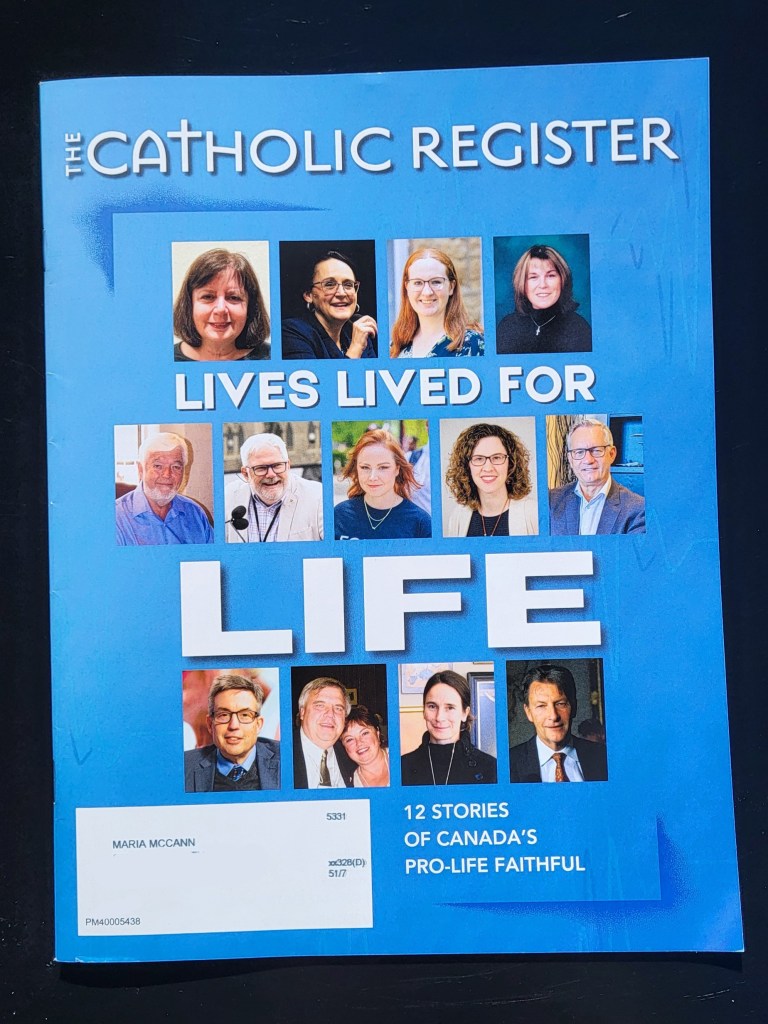
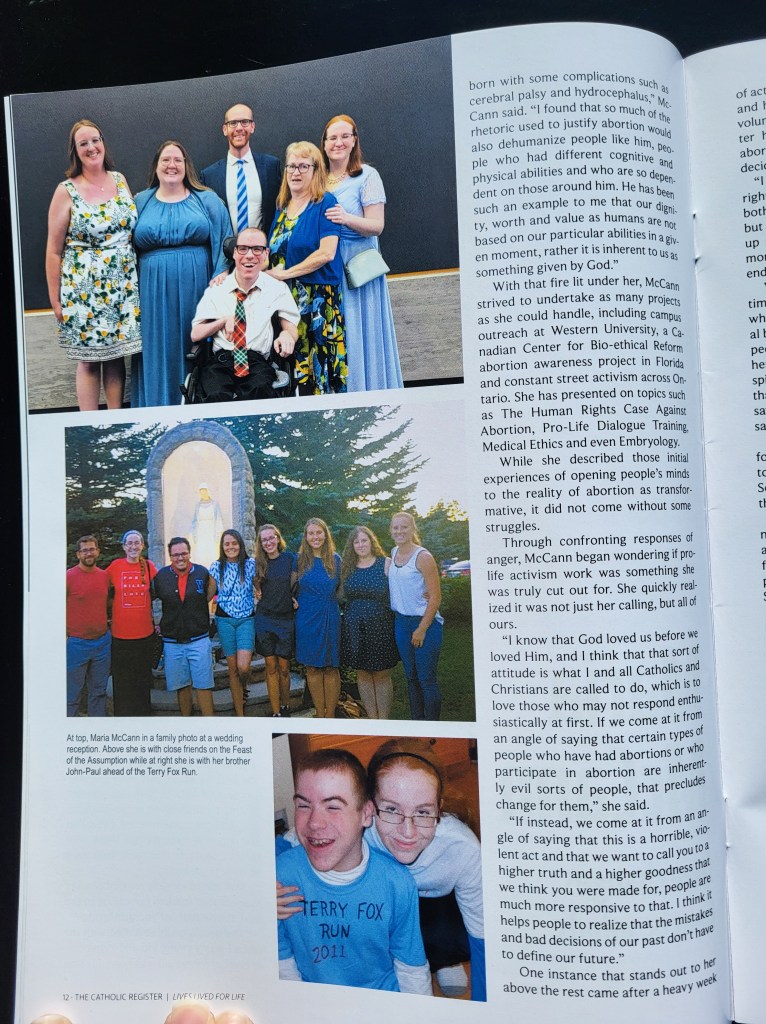
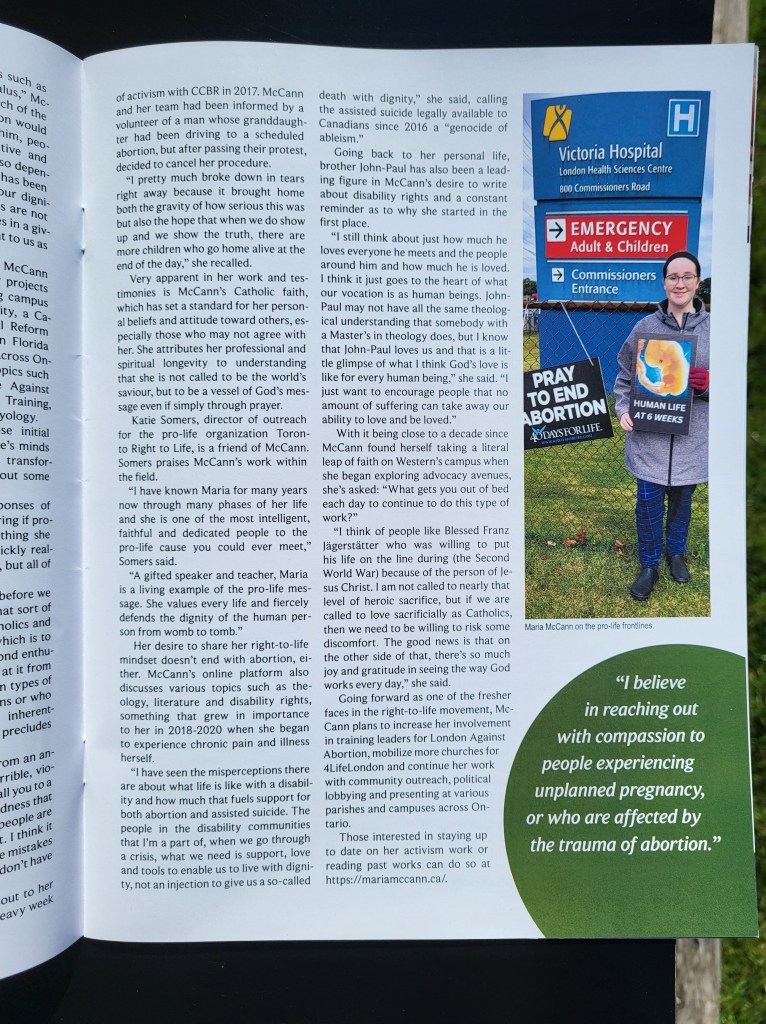
Earlier this year, I was interviewed by the Catholic Register about my involvement in the pro-life movement. I was overwhelmed and humbled to be included in their “Lives Lived For Life” issue, a special edition which highlighted 12 stories of pro-life Canadians.
My prayer is that anyone who reads the issue realizes that every one of us has a role to play in ending abortion. The pro-life movement is not about me or about you. It’s about our pre-born neighbours, little girls and boys, whom God calls us to protect from slaughter.
Get Involved: EndTheKilling.ca/TakeAction
I’m so grateful for the support of my family in doing this work, and for the countless pro-life colleagues who’ve become a second family.
Soli Deo honor et gloria!

-
Speaking from the Heart

Originally posted on March 28th, 2018 for the Canadian Centre for Bio-Ethical Reform
I felt like I was hitting a wall in my conversation with Danny at the Abortion Awareness Project. We had looked at pictures of aborted children, and we had discussed human rights and the difficult circumstances surrounding pregnancy. He would agree with my reasoning, and he even told me, “You’re really good at getting your point across.” Despite that, he kept reverting to his pro-choice position. If he understood the logic of the pro-life position, why wasn’t he convinced by it?
When we expose the truth about abortion, we see countless people become pro-life, but we also meet many who react with anger, obstinance, or apathy. We know from experience that those reactions nearly always mask some hidden wound. How can we address those deeper heart issues that block someone from accepting the truth?
The answer to this question is both simple and challenging: seek to understand. We cannot address people’s true beliefs about abortion unless we seek to understand what they believe, and why they believe it. When we seek to understand people, their deeper beliefs and their past experiences will often rise to the surface. In order to get to that point, we need to ask good questions, and then listen well to the responses.
I realized that although I was communicating intellectual arguments to Danny, I was not doing enough to seek to understand his point of view. I needed to reroute the conversation through questions and listening. So, I asked him an open-ended question: “What was it that made you decide that pro-choice was the way to go?”
He revealed to me a tragic fact: his mother had had two abortions while she was living in great poverty. At that point, I set aside the intellectual arguments and listened. I told him how sorry I was that she had gone through such difficult things. I tried to ask him gentle questions about his mother’s situation and about how she was doing now. “I guess that that experience kind of shaped the way I think about abortion,” he said. Danny told me that his mother wouldn’t talk much about the abortions, but she had expressed regret for her lost children.
Now it was perfectly clear why Danny struggled to accept the pro-life position: it would mean admitting that his loved one had made a serious mistake. I wanted to communicate to him that rejecting abortion did not have to mean rejecting his mother. So, I asked more questions: “Danny, imagine for a moment that I get a phone call. Someone tells me that my mom has been involved in a drunk driving accident that killed someone–and she was the one who was drinking and driving. Do you think that I would hate my mom because of what she did?” “Well, you’d probably be angry,” he replied hesitantly. “Yeah, I think I would be angry if someone I loved did that,” I said. “But do you think I would hate her and call her a terrible person? Do you think I would abandon her?”
He was thoughtful as he answered. “No… I think you would try to be a part of her healing journey.”
“Yeah, absolutely,” I told him. “Don’t you think it could be the same with your mom? She was part of a decision that ended someone’s life, and it’s a decision that has hurt her deeply. Don’t you think, though, that you could be a part of her healing journey?”Danny agreed with me, and we continued to discuss the impact of abortion and what it did to children and mothers. I asked him, “Do you think your mother made the right choice? Or do you think that if she’d had more support, she could have carried to term?” He was thoughtful again and said, “I think we could have made it. I think she could have done it.” He was starting to understand that his mother had needed real support, not abortion. He even asked me, “What do we need to do to prevent abortion?”
After a long discussion about his mother, Danny and I started to go back into the intellectual arguments around abortion, such as questions about prenatal development. He again expressed that our arguments made a lot of sense. “Powerful pictures,” he told me as he stared at the abortion victim photography. “You’ve kind of changed my view a bit.”
As we wrapped up our conversation, Danny and I talked about some other social issues, and he told me that he was so discouraged by all the problems with the world. “I guess that I have less and less hope for humanity,” he said with a depressed look.
I silently prayed for the right question, and one came to me: “Is there anything that does give you hope—for yourself or for others?” His face brightened, and he immediately responded, “My daughter.” He told me that his daughter was the reason that he wanted to get a job, get an education, and be a better person. I couldn’t stop smiling as he told me about this little girl whom he loved so deeply.
It can be challenging and scary to have these “heart” conversations. Every person’s story is different, and there is no perfect script for us to memorize. We can, however, be voices of truth and compassion to the people in front of us. Through our gentle questions and our intent listening, we can show people the love and respect inherent to the pro-life message.
And for hurting people, that compassion can leave a real impact. As Danny left for class, his expression was hopeful again, and his last words to me were, “Awesome conversation. Awesome conversation.”
-
Watching the Culture Shift

Originally posted on April 11th, 2018 for the Canadian Centre for Bio-Ethical Reform
It’s a cold but sunny morning in Toronto. We set up for “Choice” Chain at various street corners around Ryerson University. I’m excited because we are there for a full day of outreach, and because there are so many of us—around 20 people spread across campus, with signs ranging from 3 feet wide to 10 feet wide. Most of our signs show first-trimester abortion victims, some show first-trimester ultrasounds, and some show second-trimester abortion victims. I know that we will reach thousands of people with pictures, hundreds with pamphlets, and dozens with conversations.
“What do you think about abortion?” I ask a young woman walking by. She’s hesitant and says she doesn’t know what she thinks about it. She opens the pamphlet I have offered her. I gesture to the photo within of the aborted child and ask her, “Do you think it’s ever okay to do that to another human being?” She says no, that is never acceptable. She asks what we can do to stop abortion.
Another young man stops. He initially tells me that he’s not sure what he thinks, but after we look at the photos, he agrees that abortion is completely wrong. He says to me, “I didn’t want to see these pictures, but you’ve got to be as visual as possible.” He thanks us and leaves pro-life.
We set up at a new location. A student stops to ask me some questions. She has spoken with another volunteer at a previous “Choice” Chain—someone who had taken her through the human rights argument. She wants to know more about our position: what do we think about abortion in the case of rape? I tell her, “I think that sexual assault is a horrific crime–one of the worst things someone can do to another person. We are failing survivors by not giving them enough support. And anyone who does that kind of a crime needs to spend their life in prison.” She nods in firm agreement. I then say to her, “I also know that we live in a country where we don’t even give the death penalty to the guilty rapist. Is it fair to give the death penalty to the innocent child?” I gesture to the picture on my sign. She thinks about this and then says, “Your logic is perfect. There’s really no situation where it’s okay to kill a child, regardless of the circumstances of how they came into existence.” She then tells me that she is confused about when human life actually begins. We discuss fertilization and different developmental features, such as consciousness. She has to leave for class and tells me that she is “still hung up on when life begins” and needs to do more research on it. She thanks me and says that the conversation was “really constructive.” She has now seen abortion victim photography multiple times, has spoken to two volunteers, and she is journeying towards the pro-life viewpoint.
At another corner, I speak with a student who thinks that abortion is needed if a woman is living in poverty. We find common ground in agreeing that women in crisis need real support, and we talk about some of the concrete ways to offer that help, such as volunteering at pregnancy care centres. I then give her an analogy where a woman becomes poor not while pregnant, but while parenting a born child. I ask her, “If it wouldn’t be okay to kill a born child because her mom is living in poverty, why would it be okay to kill a child before birth for the same reason?” As we talk more and look at the pictures of aborted children, she agrees that abortion is never justified. She tells me, “I think you guys are doing a good thing here. Thank you for talking with me.”
Those are just some of the stories I have from that day. And I was just one of the many volunteers who talked to people and saw their views shift. Now add in all the people who didn’t even talk with us, but who saw our signs or accepted pamphlets.
We know how to change the culture.
When we make visible the victims of abortion, the pro-choice worldview immediately begins to crumble. I’ve heard it once said, “The phrase ‘my body, my choice’ rings hollow next to a photo of another human body brutalized by abortion.” When people see the pictures, they understand the violence of abortion. They change their minds.
And when we speak to people about respecting human rights—when we speak to them about killing problems rather than killing people—they get it. They realize that the pro-life worldview is scientifically accurate and ethically sound. They change their minds.
So, we will show the victims. And we will speak up for the victims. When we do this, we win. Over the course of one day, the pro-life consensus grew at Ryerson University, and I saw this growth with my own eyes.
It will take hard work and dedication to shift the views of our entire country. It’s not easy. But it is simple.
Will you join us?
-
Sperm, Egg, and Embryo: What’s the Difference?
Originally posted on February 22nd, 2018 for the Canadian Centre for Bio-Ethical Reform
It was about -10° during a recent “Choice” Chain, and I didn’t expect anyone to want to talk with me in such weather. Yet, within 5 minutes, Morgan stopped by my sign, and this pro-choice student was eager to have a long conversation about abortion.
As we discussed human rights and the science of human development, Morgan told me that he didn’t think we could know when human life begins. He thought that instead, human life must exist on a kind of gradient. He asked me how a single-celled zygote was any different from a sperm cell or an egg cell. I asked him, “Could a sperm left alone in a man’s body, or an egg left alone in my body, ever develop into a toddler or teenager?” “No,” he replied. “So couldn’t we agree then,” I continued, “that human life can’t begin before fertilization? And if we look at any time in a human being’s life after fertilization, can’t we still trace her life back to beginning at that point?”
He thought about this, but then objected again: “But if you take it back just a bit further, you have a sperm and an egg — they just haven’t met each other yet. So why aren’t those just half a human?”
While his tone was somewhat joking, I decided to take his question seriously: “I actually think that there is a radical difference between sperm/egg and an embryo, because a change in structure isn’t the only change that happens at fertilization. It’s not just a process of ‘1 + 1 = 2’. If you’ll bear with me for a moment, I can explain why I think that.” He nodded in agreement and I could tell he was listening.
“When scientists classify cells and organisms,” I said, “they need to look at two things: cell composition and cell behaviour. Sperm and egg have, typically, 23 chromosomes. That’s only half the genetic material needed for a human being. At fertilization, though, there’s a change in composition: the human zygote now has 46 chromosomes, a complete genetic code. And I’m sure you know about all the recombination that takes place at that time as well.” He nodded in agreement.
“There’s also a radical change in cell behaviour at fertilization,” I continued. “The behaviour of a sperm is to penetrate, and the behaviour of an egg is to be penetrated. But when sperm and egg fuse at fertilization, the new zygote doesn’t do those things. Instead, she grows and develops so that she can go through all the stages that a human being is supposed to go through. Those radical changes in cell composition and cell behaviour mark the change from gamete to organism.” (If I had remembered my apologetics better, I might have added in that the zygote has coordinated function, and self-directs her own growth.)
To prevent my explanation from sounding too much like jargon, I added in: “And you and I know this intuitively! A woman has eggs in her body, but she can’t get pregnant unless an egg is fertilized by sperm.” He again nodded in agreement.
Morgan had no response to my reasoning, and after that, he no longer presented any arguments that a human embryo was scientifically equivalent to a sperm or egg. He instead shifted his arguments back to philosophy, and argued that the embryo wasn’t deserving of human rights because she differed from us in so many ways. Nevertheless, our conversation was now grounded in the biological reality that human life begins at fertilization.
I don’t always delve that deeply into embryology with the person I’m talking to–especially if I think that I may lose their attention and interest. I brought up cell composition and behaviour with Morgan because I could tell that he had the patience for a long conversation. He had brought up many flowery philosophical terms in our conversation, so I decided that sharing more advanced information with him would show him the credibility of the pro-life perspective.
Over the course of 45 minutes, I found that Morgan’s pro-choice beliefs were deeply embedded in his utilitarian worldview and in his experiences of people close to him having abortions. Nevertheless, at the end of our conversation, he said that we had “scientific reasons” and “good arguments” to back up the pro-life position. He told me that he was going to keep thinking about the issue because it was so important, and he thanked me for having a respectful discussion with him.
I know that Morgan will need to reconsider many more aspects of his worldview before being able to accept the truth about abortion. I also know that the truth he heard and saw will leave “pebbles in his shoe.” Sharing the truth with people is always worth it—even if I sometimes can’t feel my fingers at the end of those winter “Choice” Chains.
-
What about Suffering?

Originally posted on November 10th, 2017 on the Canadian Centre for Bio-Ethical Reform
In late October, I was doing a campus “Choice” Chain with my local community group. I asked a student named Arjun what he thought about abortion, and he told me that he was pro-choice. “Where I come from in India, there are a lot of children who are homeless and living on the street,” he told me with a troubled look. “Sometimes I think, wouldn’t abortion have been better? But maybe things aren’t as bad here in Canada.” Arjun’s response and his demeanour told me something: he wasn’t pro-choice because of a lack of compassion. He was pro-choice because of misguided compassion. I needed to show him both the humanity of pre-born children, and the inhumane nature of abortion as a response to suffering.
First, I found common ground with him–something I try to do in every conversation, to show the other person that I am listening to them. “It sounds like you care a lot about people who suffer,” I said. “Things may be somewhat better in Canada, but here in London, there are still a lot of homeless people, right?” He nodded in agreement. I then asked him, “Do you ever think, though, that we should solve homelessness by killing all the homeless people, since they are suffering?” “No, that wouldn’t be okay,” he said. “So if we wouldn’t kill born people because of their suffering,” I followed up, “then why would we kill a pre-born child just because she may suffer?” At that point, I gestured down at my sign showing an 11-week-old abortion victim. His eyes went wide as he took in the image, and he said, “I’ve never thought about this.”
We then talked about human rights, and about what abortion did to children like the one pictured on my sign. While he was stunned by the image, he pointed out that killing the pre-born child was perhaps less painful than killing a born child, so wouldn’t abortion be okay? “I think you’re right that a very early embryo probably doesn’t feel pain,” I told him. “But I don’t think that pain alone makes killing wrong. I think it makes killing more wrong, because then it’s like torture.” I challenged him with a question: “Would it be okay, though, to kill born children who are homeless and suffering, as long as we give them anaesthetic first?” “No, definitely not,” he said. He continued to study the image of the dead child in front of him, and I could tell that his horror at abortion was growing. I needed to show him just a bit more that abortion was never a solution to suffering and social problems.
“One of my friends told me an interesting analogy,” I said to him. “Think about an orphanage for a second. The children in an orphanage might not all get adopted and have happy lives, right?” He agreed. “Now imagine,” I said, “that someone decides to light the orphanage on fire with the kids inside. Would our first response be to line up adoptive parents for all the kids? Is that what we’d do while the fire is burning?” “No,” he replied, “we’d save the kids.” “I’m sure you can see where I’m going with this,” I followed up. “Making sure that children have good parents and social support is really important–but it’s not much good to those kids if they’re already dead. First, we need to save the children.” He nodded in understanding. I pointed down at my sign again to drive home the reality of abortion’s violence. “And Arjun, abortion isn’t even like not being able to save kids from the fire. Abortion is like pushing the kids into the fire on purpose.”
We talked a bit more and I asked him some questions about how he was finding life in Canada. Before he left, I said to him, “Arjun, after everything we’ve talked about, do you think there’s any time when abortion is okay?” “I’d never thought about it before this conversation,” he replied. “Now I think it’s an evil thing. You guys are doing a good thing here.” We shook hands, and he left completely pro-life.
By finding common ground, using analogies, and asking good questions, we can show people like Arjun that the violence of abortion is never the right solution to human suffering. We can show them that alleviating suffering is far better than eliminating sufferers.
-
Outreach Testimonies: Using the Human Rights Argument
Originally posted on October 13th, 2017 for the Canadian Center for Bio-Ethical Reform
I was doing “Choice” Chain earlier this month with some friends through my community’s activism group, London Against Abortion. We had set up outside of one of the colleges in London to reach post-secondary students with the truth about abortion. While some college students are hostile and closed-off to discussion, many will admit that they actually have not given much thought to the issue of abortion.
Such was the case when I asked Camille, “What do you think about abortion?” as she walked by me. She stopped and was taken aback by my sign showing a 1st-trimester abortion victim, but told me that she did not know what she thought about the issue. I then asked her, “Do you believe in human rights?” She said, “Of course I do.” “Great, me too!” I replied. “And who gets human rights?” “Well, women should,” she told me hesitantly. I replied, “I agree that women should—men should as well though, right? Shouldn’t every human get human rights?” She nodded in agreement.“If two humans reproduce, what species will their offspring be?” I asked her. She told me that she was not sure what I meant, so I clarified by saying, “Well, two humans could never produce a cat, right? Won’t their offspring be of the same species—human?” She agreed again. “And if that offspring is growing,” I said, “then wouldn’t she be alive?” She nodded, and I said, “I’m sure you can see where I’m going with this. If we know from science that humans reproduce other living humans, and if abortion intentionally kills those humans, then wouldn’t abortion be a human rights violation?” At that point I drew her gaze to the image of a 10-week abortion victim in the pamphlet she was holding. She stared at the image in shock and said, “Yes, it would.” I then asked her if she thought there was ever a time when it was okay to do that to another human, and she said, “Definitely not.” We then briefly discussed the magnitude of the abortion issue, and she ended up giving me her contact info so she could get involved in ending the killing.
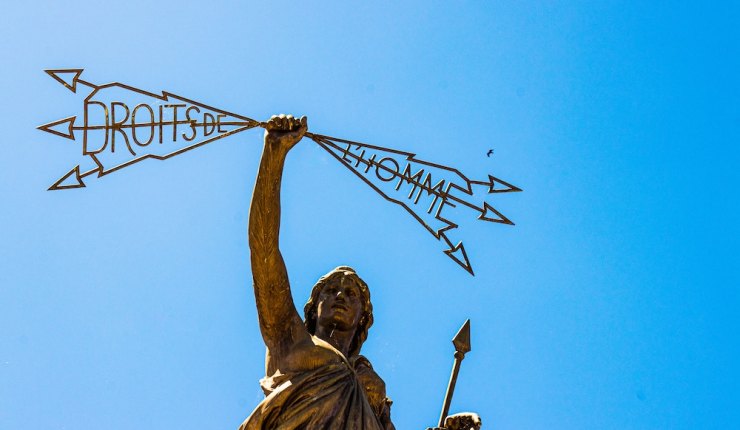
Those questions that I asked Camille together constitute what we call the Human Rights Argument. Every human deserves fundamental human rights. We know that pre-born children are human because they have human parents, and we know that they are alive by virtue of their growth. Abortion is a human rights violation, since it destroys a living human being.
The human rights argument is a powerful tool that I use in nearly every conversation I have about abortion. It quickly establishes the humanity of pre-born children and the inhumanity of abortion, and for many people it helps them connect the dots to understand why they are horrified by the abortion victim image in front of them. For some conversations, it is the launching point from which I and the other person have a longer discussion about embryology, or bodily autonomy, etc. But for many people—including Camille—the human rights argument, combined with the visual evidence of abortion victim photography, is sufficient to convince them to reject abortion.
-
Truth and Healing
Originally posted on October 31, 2017 for the Canadian Centre for Bio-Ethical Reform.
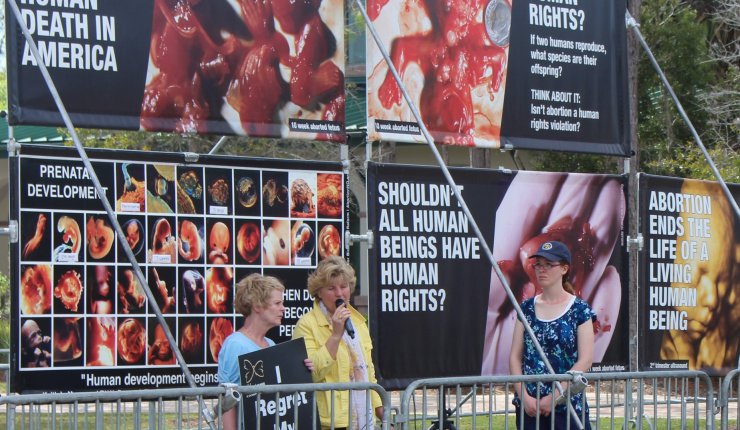
I’m standing on a street corner in Toronto, holding a sign with an image of a first-trimester abortion victim on it. Many passers-by tend to avoid my gaze and the pamphlets in my outstretched hand. A few pause to vent about why my colleagues and I are atrocious human beings who should have been aborted. A man stops in front of one of my shortest colleagues, but not to talk. He spits. She’s an easy target. It covers her face, her hair, even her arm. My eyes go wide, I fumble for my phone to film, but he’s already passed on. I rush over to help her.
I’m standing on the exact same street corner, probably even holding the same sign, more than a month later. I ask an older woman what she thinks about abortion. “I had one years ago,” she tells me quietly. “I regret it to this day.” I try to stammer out some words of sympathy and support, but she crosses the street. Out of my reach. Around 20 minutes later, she crosses back to my corner and stops in front of my sign again. “There was no one doing this when I had mine,” she says to me. “Thank you for being here.”
No one had been there to share the truth about abortion with her when she needed it.
I’m sitting in a coffee shop in London a week later. I’m trying to keep my mind off the abortion debate, and on the task at hand: preparing a presentation for one of my classes. I forget that the bold “EndTheKilling.ca” sticker on my laptop makes me an easy target for questions. The man in the booth across from me asks, “What killing? Is it about the seal-hunt?” I’m momentarily confused, then realize what he’s asking about. “No, not about the seal-hunt. It’s about the killing of pre-born children,” I tell him. “Ah, abortion,” he says, and I nod. “Yeah, you can find more information on the website if you’re interested.” I smile, and try to return my focus to my work.
A couple minutes later, he gets up from his booth, and says, “I’m sorry. I shouldn’t have asked.” I glance up and see the tears in his eyes, hear the choke in his voice. “We lost a child—and—I shouldn’t have asked.” He’s about to go out the door. Out of my reach. I hastily say, “I’d be happy to have a conversation if you have a minute.” He stops, I get up, and ask him more about the situation. It was decades ago, he tells me. They got pregnant and they weren’t ready. She didn’t want to embarrass her family. So they got rid of the problem… “It only dawned on me recently,” he tells me through tears, “that it was a person.” I ask some questions about their situation, offer words of sympathy and support, and tell him about the group Silent No More. We shake hands, exchange names, and then he has to leave.
We get so little time with people. So little time to speak truth, to show love, to share our message. But we must share the life-saving truth—with as many people as possible. That’s what the images do. Nothing communicates the truth about abortion as quickly or as effectively as abortion victim photography. No one can tell the story of the aborted pre-born child like she herself can.
When Pope Francis referred to the Armenian genocide as a genocide—when he called the evil what it was—he provoked outrage from political groups who found that statement very politically incorrect. He refused to shy away from the truth and instead stressed the need to share it: “Concealing or denying evil is like allowing a wound to keep bleeding without bandaging it.”
The truth about an injustice can be so hard to accept. Our culture is so deeply wounded by abortion, and so desperate for healing. But no healing will begin unless it first takes place in the light of the truth. And no one will receive the truth unless we first have the courage to share it.
-
The call for an ethical conversion: seeing the faces of the pre-born
Originally posted on March 17, 2016 for the Canadian Centre for Bio-Ethical Reform.
Several years ago, I encountered the ideas of the Jewish philosopher Emmanuel Levinas while I idly skimmed my high school religion textbook. I was intrigued by his philosophy of “the face-to-face.” Levinas argues that when we encounter another human being face-to-face, we become ethically responsible towards that human being. He declares that “The approach to the face is the most basic mode of responsibility” towards “the Other.” I felt intuitively that his philosophy was true, but like most of my high school learning, his ideas fell into some cluttered filing cabinet at the back of my brain.
Levinas’ theory of the face-to-face came back to me in a surprising way two weeks ago, when I participated in CCBR’s Genocide Awareness Project. Under the guidance of CCBR’s incredible staff, I and my fellow participants visited two university campuses in Florida to speak with students about the injustice of abortion. We handed out thousands of pamphlets, had conversation after conversation, and wrote down testimony after testimony of moved hearts and changed minds. But our words were not the primary tool that engendered those effects on the campuses. Behind us, on large signs, were images of pre-born children who had been subjected to the violence of abortion. This abortion-victim photography showed the graphic and disturbing truth of what happens 3000 times a day in the US. When I asked students what they thought about abortion, those who said they were “pro-choice” often had a note of hesitation or embarrassment in their voice. The reason is simple enough: when we are faced with what choice we are talking about, the pro-choice label rings a bit hollow.
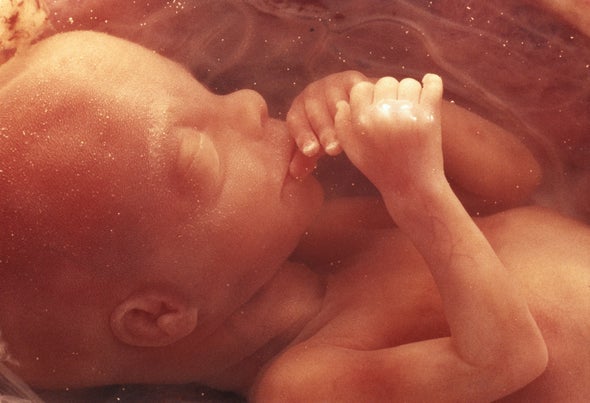
I remember one woman in particular who stopped by our display at FIU. The woman politely declined to speak with me, saying that she was “just there to look at the pictures.” I heard the horror in her voice when she said, “you can see their faces!” For many people like her, an encounter with the face of a murdered pre-born child stripped away every flimsy argument in support of abortion. However, not every student who saw our signs immediately voiced pro-life convictions. Some became angry, even belligerent. Though the students reacted in a variety of ways, I think that every kind of reaction can be explained through the lens of Levinas’ philosophy. In the book Ethics and Infinity, he states:
The first word of the face is ‘Thou shalt not kill’. It is an order. There is a commandment in the appearance of the face, as if a master spoke to me. However, at the same time, the face of the Other is destitute; it is the poor for whom I can do all and to whom I owe all. And me, whoever I may be, but as a “first person,” I am he who finds the resources to respond to the call.
If an encounter with the face causes a recognition of responsibility towards the Other, then an encounter with the face of the murdered pre-born child forces a realization: we have radically failed in that responsibility. We have failed that child. The primary “order” of the face, “Do not kill me!”, has been disregarded. The total vulnerability of the pre-born child, the one to whom we “owe all”, has been violently exploited. It is therefore very natural that people reacted with negative emotions: sorrow, horror, shock. Fury. Some desperately clung to their state of denial. But so many people that we talked to did accept the difficult truth. They agreed that abortion was a human rights violation, and agreed that we bear responsibility towards the pre-born. In my conversation with a student named Jack, he went from moderately pro-choice to completely pro-life after seeing the images and hearing our arguments. When I asked him if he thought that the pre-born needed protection, he declared that they need “the most protection” and that “silence is violence” on this issue. He saw their faces, and he took responsibility.
The faces of the pre-born do not merely convict us of the injustice of abortion and our failure in responsibility; their faces also call us to greater action in the future. Their faces call us to “do all” to end abortion, to save those to whom we “owe all.” I cannot phrase it better than Levinas himself: “The word of God speaks through the glory of the face and calls for an ethical conversion, or reversal, of our nature. What we call lay morality, that is, humanistic concern for our fellow human beings, already speaks the voice of God.” This ethical conversion, a rejection of selfishness, is desperately needed in our culture of death. Through the faces of the pre-born, God calls us to this conversion. How will we respond?
Ableism abortion adoption apologetics beauty Bible biology bodily autonomy books Catholic Catholicism Christian christianity Christian poetry chronic illness chronic pain CS Lewis culture disability euthanasia faith family God Inclusion John Milton literature London Ontario Love MAID ODSP philosophy Poetry politics prescription pro-life pro-life speaker reflection RM Rilke Suicide Prevention Sylvia Plath Teresa of Avila theology TS Eliot value Viktor Frankl

Pro-life speaker & activist. Poet. I also write on disability, theology, literature, & more.

